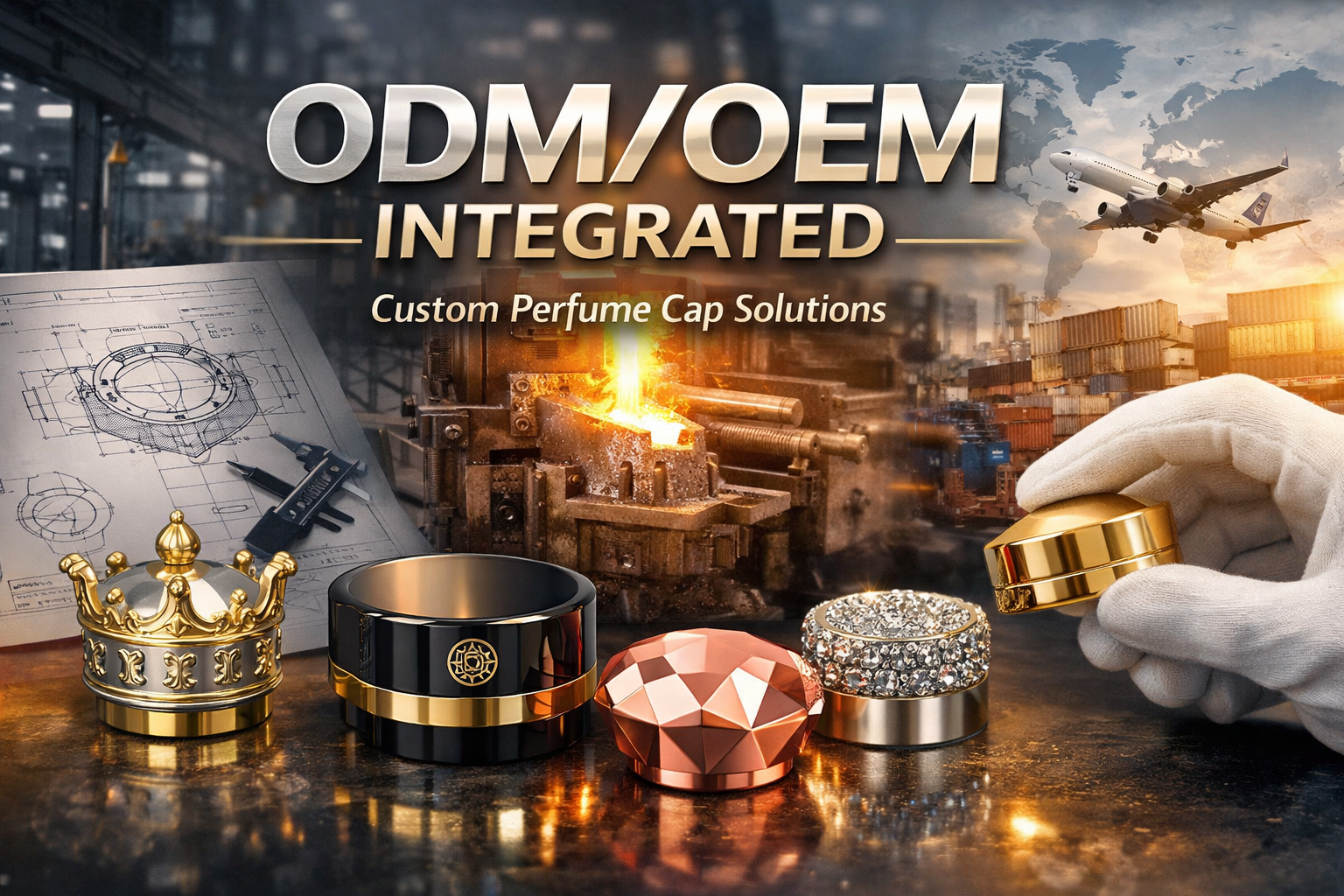
In today’s highly competitive perfume market, packaging is no longer just a “container,” but a crucial expression of brand value. Perfume bottle caps, in particular, are one of the first details consumers encounter; their materials, craftsmanship, and design directly impact a brand’s premium feel and brand recognition. For brands, choosing a factory that integrates ODM/OEM and trading is becoming a vital path to achieving product differentiation and efficient supply chain collaboration.
I. Advantages of the Integrated ODM/OEM + Trading Model
Compared to traditional perfume packaging supply chains, which often involve multiple links—design companies, manufacturing plants, trading companies, etc.—this model is less costly, time-consuming, and carries uncontrollable risks. The ODM (Original Design Manufacturer)/OEM (Original Equipment Manufacturer) integrated trade model combines design, development, production, and export, offering significant advantages:
Shortened Development Cycle: From concept design to sample confirmation and mass production, the integrated process reduces intermediate communication steps.
Cost Optimization: Avoiding multiple intermediaries increases price transparency.
Quality Control: Direct factory-to-brand interaction ensures consistency in materials and processes.
Rapid Response to Market Changes: More flexible adjustments to design and order size.
This model is particularly important for customized zinc alloy perfume bottle caps due to their complex processes and diverse design requirements.
II. Core Value of Zinc Alloy Perfume Bottle Caps
Zinc alloy, as one of the mainstream high-end materials for perfume bottle caps, combines functionality and aesthetics:
- Excellent Plasticity
Zinc alloy is suitable for die casting, enabling complex structural designs such as relief, hollowing, and 3D engraving, satisfying brands’ pursuit of personalized appearances.
- High-End Texture
Through surface treatments such as electroplating, spraying, brushing, and antique finishing, zinc alloy bottle caps can achieve a metallic luster or artistic effect, significantly enhancing the product’s grade.
- Durability and Stability
Compared to plastics or ordinary alloys, zinc alloys have higher strength and corrosion resistance, making them suitable for long-term use and transportation.
III. Customization Process Analysis: From Idea to Mass Production
In the ODM/OEM factory trading integrated model, customizing zinc alloy perfume bottle caps typically involves the following key steps:
- Concept Design and Brand Integration
The client provides brand positioning, target market, and design references. The factory design team creates preliminary design schemes (2D/3D renderings).
- Mold Development
After design confirmation, the mold-making stage begins. This is the core step determining the product’s precision and detail.
- Prototyping and Testing
Samples are used to verify dimensions, structure, surface effects, and compatibility with the bottle body, ensuring the product meets expectations.
- Surface Treatment and Process Selection
Electroplating colors (e.g., gold, rose gold, gunmetal), spraying effects, or inlaid decorations (e.g., rhinestones, gemstones) are selected based on brand requirements.
- Mass Production and Quality Control
The factory uses standardized processes for die casting, grinding, electroplating, and assembly, and implements a strict quality inspection system.
- Packaging and Export
The advantages of integrated trade are reflected in the export process, providing one-stop customs clearance, logistics, and delivery services.
IV. Design Trends: From Function to Emotional Expression
Current perfume bottle cap design is shifting from a single function to “emotional expression”:
Jewelry-like design: Creating bottle caps with a visual effect similar to jewelry.
Brand symbol reinforcement: Three-dimensional and sculpted logos.
Multi-material integration: Combining zinc alloy with glass, acrylic, leather, etc.
Environmental protection and sustainability: Recyclable materials and environmentally friendly electroplating processes.
These trends place higher demands on the factory’s design capabilities and process integration capabilities, which ODM/OEM integrated factories possess.
V. How to Choose a Suitable Partner Factory?
Choosing the right ODM/OEM factory requires considering:
Independent design capabilities (ODM capability)
Mature die-casting and surface treatment processes
Support for small-batch customization and flexible MOQ
Export experience and trade service capabilities
A stable quality control system
A mature integrated “factory + trade” supplier is not only a producer but also a partner for brands.
In summary, against the backdrop of continuous upgrading in the perfume industry, packaging has become a crucial dimension of brand competition. Customized zinc alloy perfume bottle caps, with their unique material advantages and design potential, are helping more and more brands create a differentiated image. The integrated ODM/OEM factory and trade model provides an efficient and reliable path to this process.
In the future, as consumers’ demands for quality and aesthetics increase, this integrated cooperation model will become the industry mainstream. Click here to drive perfume packaging to a higher level of development.