
Zamac Cap MOQ, Tooling and Lead Time: What to Confirm Before You Send an RFQ
Ask two custom zinc alloy perfume cap manufacturers to quote the same zamac perfume cap and one will come back 40% higher. The instinct is to assume margin padding — but in most cases the two quotes are answering two different questions, because the enquiry left the variables open.
Custom metal closures are not a commodity with a list price. A zamac cap is priced on gram weight, cycle time, tool complexity, finishing stack and order quantity. If you do not specify those, every supplier fills the gaps with their own assumptions — and you end up comparing apples to aeroplanes.
This guide walks through what actually drives cost and schedule, why MOQ on a zamac cap sits where it does, what you should insist on before a mould is cut, and the checklist to attach to your next RFQ. It is written for brand owners, packaging buyers and sourcing managers evaluating a custom zinc alloy perfume cap manufacturer for the first time.
The five variables that decide your unit cost
There is no price table here, and any supplier who hands you one without a drawing is guessing. What you can control is the specification.
1. Cap weight and wall thickness. Zamac is bought by the kilogram and cast by the shot. A 68 g cap and a 34 g cap off the same tool are not half the cost apart — but the lighter part cycles faster and uses less metal. If budget is tight, ask your factory to core out non-visible mass from underneath. This is the single highest-leverage cost lever, and it costs nothing but a DFM conversation.
2. Structural complexity and part count. A one-piece die cast shell is the efficient case. Add a threaded insert, a separate inner liner, a magnetic assembly or a two-piece screw construction and you add operations, assembly labour and yield risk. The extra components are usually where a “simple” cap becomes an expensive one.
3. Tooling: private mould vs. shared, single-cavity vs. multi-cavity. A private mould is the only route to a genuinely ownable shape. Multi-cavity tools cost more up front but reduce per-unit cost on volume. Your factory should tell you the cavity count they recommend for your annual volume — if they cannot, they are not engineering the tool, they are just cutting one.
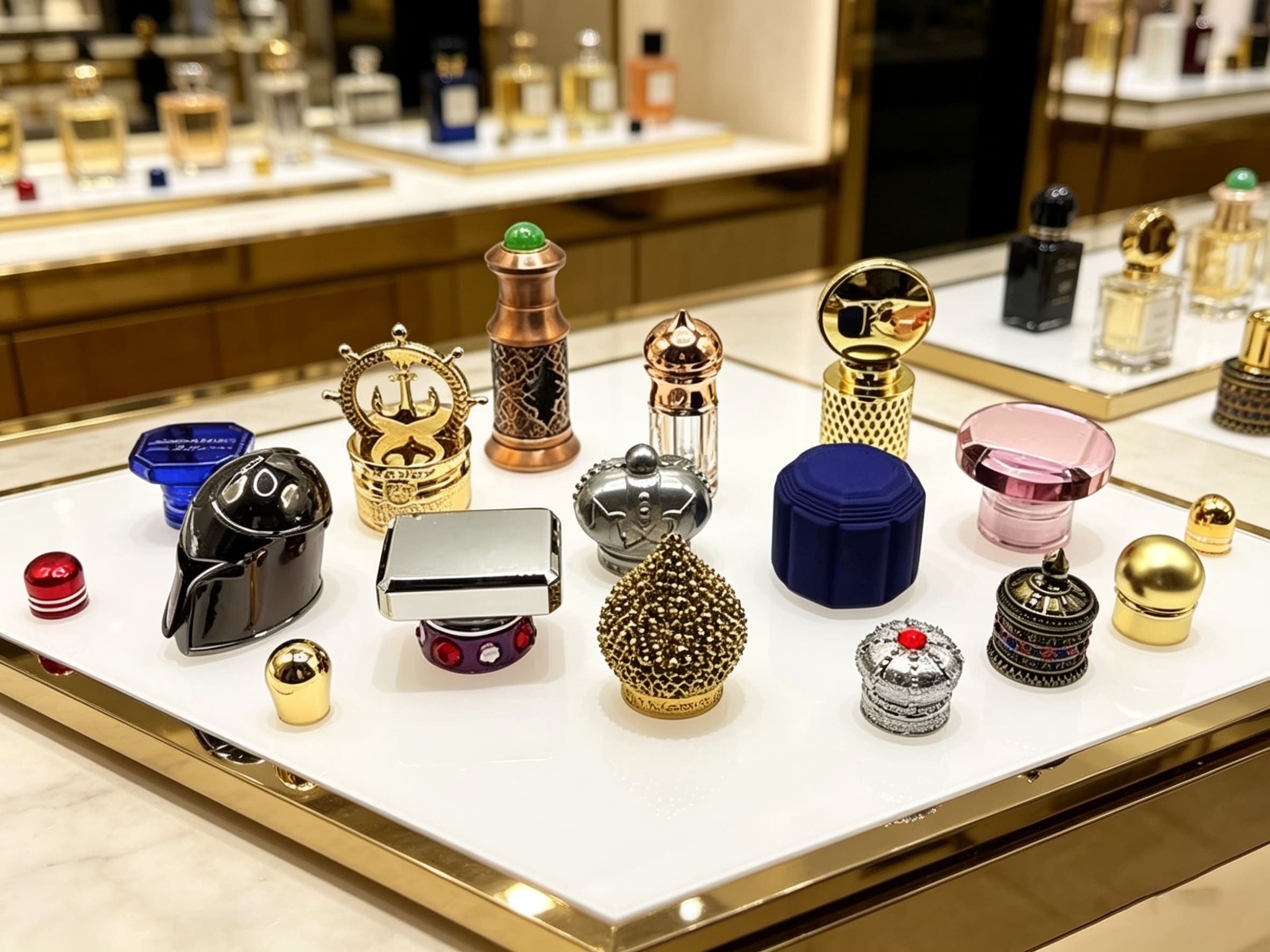
4. Surface finishing stack. This is the most underestimated line. Auto-polishing is fast and consistent; hand-polishing is slower and needed for complex geometry. Then comes the plating stack — copper, nickel, and a decorative top layer — plus optional PVD, e-coating, lacquer, sandblasting or antique patina. Each additional layer is a process step with its own yield loss. Two finishes that look identical in a photo can differ meaningfully in cost.
Each plating layer is a separate process step with its own yield loss.
5. Quantity, and how it is split. Total order quantity matters, but so does how it divides across colours and SKUs. Ten thousand pieces in one finish is a very different production job from ten thousand split four ways, because every finish change means a plating line changeover.
MOQ explained: why zamac caps start where they do
The question behind “small moq zinc alloy perfume cap” is usually not curiosity — it is a brand with a launch quantity and a supplier telling them it is too small. Here is the honest arithmetic.
A typical MOQ (minimum order quantity) for a fully custom zamac cap sits around 3,000–5,000 pieces. That number is not arbitrary. Three things set it:
- Die casting setup. A hot-chamber machine has to be set up, warmed and tuned. Short runs amortise that setup over too few parts to make sense.
- Plating minimum lot. A plating line runs baths. Below a certain lot size you are paying for bath chemistry and line time rather than for parts.
- Polishing line changeover. Fixtures, compounds and wheel setup are per-geometry. One more changeover costs the same whether it makes 500 caps or 5,000.
Four ways to work with a lower launch quantity:
- Adapt a stock tool. Take an existing geometry and change the logo, the finish and the internal fit. Tooling cost drops sharply and MOQ usually follows.
- One geometry, several finishes. Order 5,000 total split across two colours instead of 2,500 each on two separate tools.
- Consolidate your first buy across SKUs — if you have three expressions in the same bottle, one closure geometry serves all three.
- Ask directly. Factories that run their own tool room and plating line have more room to accommodate a trial order than trading companies that buy both in.
If a supplier quotes a very low MOQ without asking about weight or finish, treat it as a signal to dig into whether that zinc alloy bottle cap supplier actually owns the production.
Tooling and mould ownership: five questions to ask
The mould is usually the largest single up-front cost in a custom closure project, and ownership terms are where disputes start later. Get all five answered in writing before you pay:
- Who owns the tool? In most OEM arrangements the customer owns it even though it physically stays at the factory. Confirm it, and get it in the contract.
- Can the tool be transferred? If you move production in two years, can the mould leave? A factory with an in-house tool and mould department can usually release it; a subcontracted arrangement may not be able to.
- What is the tool life, and who pays for refurbishment? Dies wear. Know the expected shot life and whether mid-life refurbishment is billed.
- Is it single or multi-cavity — and why? The answer should follow from your annual volume.
- What happens if we do not reorder for 24 months? Storage, maintenance and reactivation terms are worth ten minutes now.
A private mould is the only route to a genuinely ownable shape.
Sampling: four stages, not one
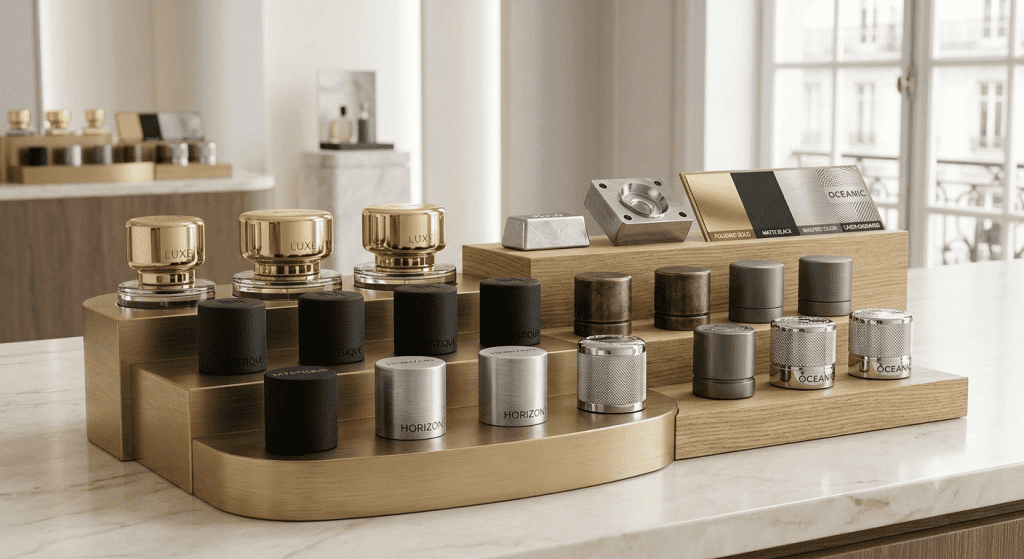
“Send me a sample” is not a specification. A professional sampling sequence has four gates, and skipping any of them is how a bad finish reaches a filling line.
| Stage | What you receive | What you are approving |
|---|---|---|
| 3D drawing / render | Digital model, often with a printed or CNC prototype | Form, proportion, weight estimate |
| T1 sample | First parts off the production tool, in the specified finish | Geometry, fit to your bottle neck, surface quality |
| Range boards | Physical panels showing acceptable and unacceptable colour, plating and defect limits | The quality boundary — signed by both sides |
| Golden sample | The sealed reference part that mass production will be matched against | The standard for dispute resolution |
Two notes from experience. First, range boards feel like paperwork until the day you have a colour disagreement with a shipment already on the water — then they are the only thing that settles it. Second, always test the T1 sample on your actual bottle, not a nominal one. Perfume necks are nominally FEA 15 mm and spirits bores nominally 18.5 mm, and in both cases real glass varies.
Realistic lead times
| Stage | Duration |
|---|---|
| Quotation (drawings supplied) | ~2 working days |
| DFM review and design freeze | 3–5 days |
| Mould making | ~25 working days |
| T1 sample | ~15 days |
| Range boards / golden sample approval | 5–7 days |
| Mass production | 25–30 days, quantity-dependent |
| QC, packing, handover | 5–7 days |
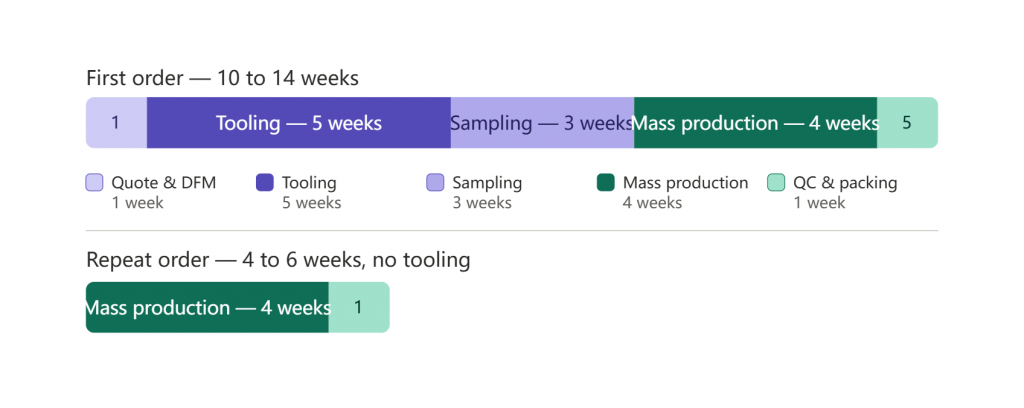
| First order, start to goods ready | 10–14 weeks |
| Repeat order, tool exists | 4–6 weeks |
Plan backwards from your launch date, then add two weeks. The two most common schedule killers are late glass drawings (you cannot finalise a fit without them) and finish approval cycles that involve more than three stakeholders.
The 18-point RFQ checklist
very line you leave blank costs about a week of clarification email with your zamac cap manufacturer. Below is the full list in plain text — copy it straight into an email, fill in the blanks and send it with your drawings. If you would rather send a filled-in form, use the spreadsheet below.
Product
- Application — perfume / wine / spirits / candle / other: ______
- Bottle or vessel supplier, plus neck finish drawing (PDF): attached? ______
- Neck spec — FEA 15 / FEA 13 / 18.5 mm / 21.5 mm / other: ______
- Closure type — friction / magnetic / threaded / screw / dropper: ______
- Target weight: ______ g
- Alloy grade — Zamak 3 / Zamak 5 / please advise: ______
Design
- 2D drawings (PDF/CAD): attached? ______
- 3D file (STEP / IGES / STL): attached? ______
- Logo method — emboss / deboss / laser / epoxy infill / print: ______
- Finish: ______ (Pantone reference or physical sample attached? ______)
- Special process — antique / PVD / sandblast / two-tone / other: ______
Commercial
- Target quantity per SKU: ______
- Number of SKUs / finishes: ______
- Estimated annual volume: ______
- Incoterm — FOB / EXW / CIF / DDP: ______
- Destination market(s): ______
- Compliance documents required — REACH / RoHS / Prop 65 / FDA / EU 10/2011 / other: ______
- Target delivery date: ______
Download the fill-in version: GCX_RFQ_Spec_Sheet.xlsx
Six signals when qualifying a zamac cap factory
You are choosing a production partner for a part that will sit on your product for years. Beyond the quote:
- In-house tooling. A factory with its own mould shop controls both quality and the 25-day tooling schedule. One that subcontracts adds a handoff and a variable.
- In-house plating or a named, audited plating partner. Surface is where zamac caps fail. Ask who plates and whether you can audit them.
- Published testing. Salt spray, alcohol immersion, friction/abrasion, adhesion, drop and pull-force tests — with actual acceptance criteria, not just “we test”.
- Inspection structure. Look for in-process inspection at every stage plus pre-shipment sampling, and ask what AQL they work to.
- Range board process. Any factory that ships luxury closures without agreed physical limits will eventually ship you a colour you did not approve.
- Engineering response. The best signal is a supplier who pushes back on your drawing — a wall thickness that will not fill, a draft angle that will not release, a crest too fine for the tool. Silence is not agreement; it is usually inexperience.
FAQ
What is the typical MOQ for a custom zamac cap?
Around 3,000–5,000 pieces for a fully custom geometry. Lower quantities are usually possible by adapting an existing tool, or by pooling several finishes on one geometry. Ask your supplier which route fits your launch volume.
Why do two factories quote so differently for the same cap?
Almost always a different set of assumptions — part weight, wall thickness, plating stack, cavity count and inspection level. Send the 18-point checklist and the quotes become comparable.
How long does a first custom order take?
Roughly 10–14 weeks from signed drawings to goods ready, including tooling at ~25 working days, sampling at ~15 days and mass production at 25–30 days. Repeat orders on an existing tool run 4–6 weeks.
Who owns the mould?
In most OEM arrangements the customer does, even though the tool stays at the factory for production. Confirm ownership, transfer rights and reactivation terms in writing before you pay for tooling.
Can I get samples before committing to tooling?
Yes — a 3D render or prototype comes first, then a T1 sample off the real tool. Always test the T1 sample on your production bottle, because glass neck dimensions vary from nominal.
Do you support OEM and ODM?
Both. OEM means we build to your drawing; ODM means our design team develops the geometry with you from a brief. Most brand projects sit somewhere in between.
Next step
Send the checklist above with your drawings and we will return DFM feedback and a quotation within two working days. Our in-house tool and mould department delivers moulds in about 25 working days, and samples in about 15 days.
Request a Quote → | See our OEM/ODM process →
GuanChengXin (GCX) — a custom zinc alloy perfume cap manufacturer with 100+ employees, 80+ machines, in-house tooling, die casting, polishing, plating and assembly. Dongguan, Guangdong, China.