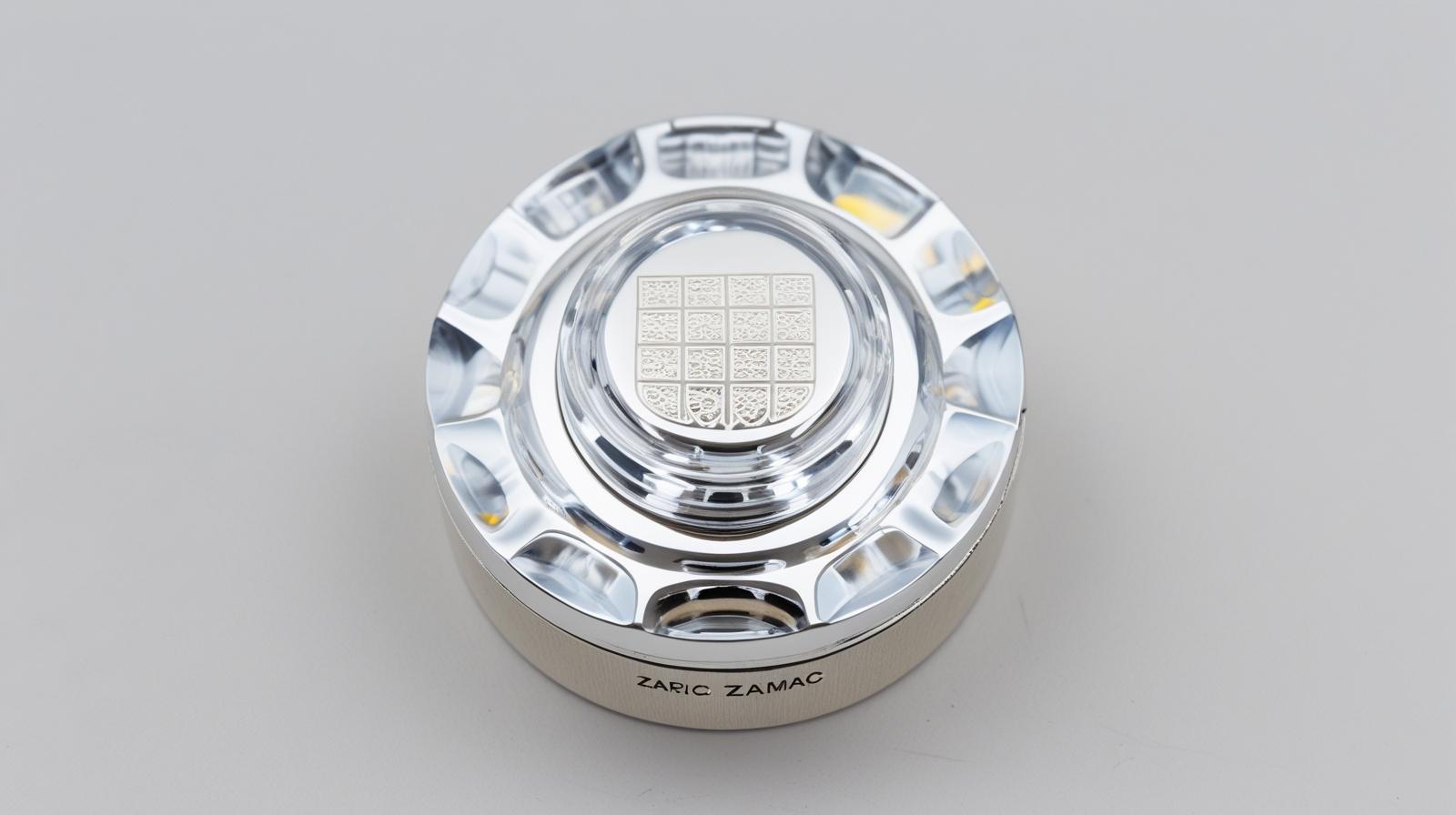
As a perfume bottle caps manufacturer, GCX works with zamac zinc alloy every day. Zamac is the standard choice for premium caps because it casts cleanly, holds fine engraving, and gives a cap the solid feel that signals quality. The same qualities also make the surface vulnerable. Humidity in transit, alcohol-based fragrance, hand sweat, and repeated opening all attack an untreated cap. Corrosion, whitening, peeling and discoloration do not spoil one unit only — they change how an entire fragrance line reads on the shelf.
This guide explains which surface treatments actually protect a zamac cap, how the layers work together, and what to agree with your supplier before the first article sample. It also corrects a persistent misconception that appears in many generic articles: anodizing is an aluminium process and is not a valid finish for zamac. The equivalent route for zinc alloy is chemical conversion, described below.
Why a Zamac Cap Needs a Planned Finish Stack
A finish on a zamac cap does two jobs at once. It sets the appearance the brand sees, and it forms the barrier between the zinc alloy and the fragrance, the alcohol, and the handling environment. Those two jobs do not always point to the same process. A bright plated surface can be thin enough to wear at contact points, while a heavier coating stack protects the part but softens the depth of engraved detail.
For that reason, specify the finish as a sequence rather than a single name. A complete stack has four stages:
| Stage | What it does | What to confirm |
|---|---|---|
| Surface preparation | Cleans and textures the casting so the coating can bond | Degreasing, polishing quality, etching or adhesion promoter |
| Base layer | Provides corrosion resistance and level the surface | Trivalent chromium or chromium-free conversion, electrophoretic primer |
| Decorative layer | Carries colour and metallic appearance | Plating metal, PVD target, powder or paint colour |
| Top sealer | Protects the decorative layer from perfume and handling | Sealer chemistry compatible with the actual formulation |
Ask the supplier which layer carries the colour, which one carries the corrosion resistance, and what happens to the stack at the thread and at the contact face with the bottle. A finish qualified on a flat sample can still fail at these two interfaces. Browse the zamac perfume caps we protect with these coatings.
The environments a cap has to survive are specific:
– Humidity and salt-laden air during shipping and storage – Perfume oils, alcohol, and chemical residues at the neck – Hand sweat, fingerprints, and frequent opening and closing – Long-term retail display and cross-ocean transport
Without a planned stack, a zamac cap loses gloss and starts to corrode early. More on surface coating durability across our cap range.
Surface Preparation Comes Before Any Coating
The finish can only be as good as the casting underneath it. Zinc polishing quality directly determines plating adhesion and final gloss: a casting with porosity, leftover parting lines, or uneven buffing will show through the plated layer. Preparation is where most finish failures originate, not at the plating tank.
Three issues come up repeatedly on complex cap shapes:
Adhesion. A coating that does not bond to the substrate fails early. Thorough cleaning plus surface preparation — etching or an adhesion promoter — reduces this risk. Confirm the adhesion test method before the first article rather than after a complaint.
Coating thickness uniformity. Deep recesses, engraved lettering, and the undercut at the neck are hard to coat evenly. Uneven thickness means uneven protection. Controlled process parameters or automated application help keep the layer consistent.
Compatibility between processes. High-temperature steps can change the mechanical properties or dimensional integrity of a zamac part. The surface treatment plan has to be designed together with casting and machining, not added at the end.
For buyers selecting a partner, the practical takeaway is that die casting protective surface treatment should never be an afterthought. Confirm early whether the factory controls the full chain — casting, polishing, plating, and inspection — because each stage changes how long the finish survives. A cap that sits in a warehouse, travels through humid logistics, and spends months on a shelf stays sale-ready only if the protective layer was engineered in.
Main Surface Treatment Options for Zamac
Electroplating. The most widely used treatment for zinc alloy caps. An electric current deposits a thin, precise layer of metal onto the cap. Common plating metals include gold, silver, nickel and chrome; each gives a different colour and a different level of hardness. Plating improves chemical resistance, surface hardness, and delivers the metallic lustre that luxury brands expect. It is cost-effective at scale.
Trivalent chromium and chromium-free conversion. These replace hexavalent chromium with a compliant nanocoating. They provide corrosion and fingerprint resistance with strong adhesion, and suit mass-produced caps for export markets. Note the correction mentioned earlier: articles that recommend “anodizing” for zamac are describing an aluminium process. For zinc alloy, conversion coating is the functional equivalent.
Cathodic electrophoresis plus baking paint. A two-layer system: a uniform electrophoretic base followed by a durable topcoat. It is pinhole-free, adheres tightly, resists UV and scratching, and keeps colour stable. It supports multi-colour finishes and works well for gift sets and sea freight.
Powder coating. A dry powder is charged and sprayed onto the cap, then heated until it melts into a uniform layer. It resists chipping, scratching and fading, offers a wide colour and texture range, and produces minimal waste with no volatile organic compounds.
Physical vapour deposition (PVD). The coating material is vaporised in a vacuum and deposited as a thin, highly adhesive layer. PVD is thin but extremely hard, with the best scratch and tarnish resistance of the common options, and a finish valued in premium packaging. It carries a higher cost.
Nano-ceramic and DLC coatings. Ultra-hard, inert, low-friction layers for high-touch caps. They resist hand sweat, frequent use, and chemical exposure, and are the premium choice when a cap will be handled repeatedly.
Polymer-based coatings. Epoxy and polyurethane systems add a further barrier with strong adhesion and chemical resistance, useful when the cap will meet aggressive formulations. Detailed perfume cap surface treatments show how these compare across materials.
How the options compare
| Treatment | Tarnish resistance | Scratch resistance | Corrosion & perfume resistance | Cost profile |
|---|---|---|---|---|
| Electroplating (gold / chrome) | Excellent | High | Very high | Cost-effective / medium |
| PVD | Superior | Outstanding | Extreme | Premium |
| Conversion / passivation | High | Medium | High | Medium |
| Powder coating | Medium | High | High | Low / medium |
| Electrophoresis + baking paint | High | High | High | Medium |
| Nano-ceramic / DLC | Superior | Outstanding | Extreme | Premium |
Tarnish resistance keeps a cap looking new on a retail shelf: gold and chrome plating block air oxidation, while PVD holds its initial lustre longest. Scratch resistance matters at contact points — chrome and nickel plating raise hardness, powder coating adds a thick protective layer, and PVD gives the hardest surface of the group.
How to Choose the Right Coating for Your Caps
Start with the job the cap has to do, then work backwards to the finish.
– Maximum corrosion resistance with an eco-friendly route: zinc-aluminium-magnesium multilayer coating plus chromium-free passivation. – Cost-effective export programme: trivalent chromium passivation. – Multi-colour and gift packaging: electrophoresis plus baking paint. – High-end fragrance: nano-ceramic or DLC coating. – High-touch retail handling: PVD, where scratch and tarnish resistance justify the premium.
Four factors narrow the shortlist further. Budget sets the ceiling — plating is generally cost-effective while PVD is a premium choice. Brand image decides whether the finish should read bright and reflective or soft and matte. Functional requirements define how much resistance the cap actually needs. Production volume matters too: some treatments suit large runs better than limited editions.
Environmental conditions deserve their own line in the specification. A cap for a spirits bottle sits in a humid bar environment and meets aggressive liquid; a zinc alloy whisky cap benefits from electroplated or PVD finishes that resist tarnish through years of opening and closing. A cap shipped by sea needs a stack qualified for that route, not just for the factory bench.
Quality Control and Incoming Inspection
Agree the acceptance criteria before the first article, not after. The checklist should cover four areas:
– Corrosion testing against a recognised method such as ISO 9227, with the duration and pass criteria set to the customer’s own standard. We do not quote a fixed salt-spray number in a general guide because the right test window depends on the formulation, the market, and the agreed specification. – Adhesion testing, using a defined tape or cross-hatch method (ASTM B571 is a common reference). – Hardness and scratch resistance, measured with a stated method rather than a visual impression. – Visual inspection under an agreed light source, with a sealed reference sample.
Record the agreed sample as the reference. A later change of liner, resin, or plating chemistry is a re-qualification question, not a cosmetic one. For an incoming inspection routine, the same four checks are repeated on production lots so a drift in the plating bath is caught before it reaches filling.
Our corrosion resistant perfume cap finishes are qualified against the specification agreed with each customer; the reference sample governs acceptance.
Appearance and Brand Customization
A cap is often the first point of contact with a fragrance, so finish choices are also brand choices. The material underneath changes what is possible:
| Material | Typical treatments | Brand reading |
|---|---|---|
| Glass | Frosting, polishing, etching | Premium, clear, decorative |
| Plastic | Electroplating, UV coating, soft-touch | Cost-effective, versatile |
| Metal (zamac) | Plating, PVD, conversion, brushing | Luxury, solid, precise |
| Wood | Lacquering, staining, carving | Natural, eco-oriented |
Within metal caps, brushing adds texture, plating adds colour and lustre, and PVD adds wear resistance. A luxury brand may choose a metal cap with intricate surface treatment; an eco-led brand may prefer wood with a natural finish. The surface treatment should reinforce that positioning instead of fighting it.
Customisation brings three practical challenges. Intricate designs demand more capable tooling and finishing control. Bespoke finishes raise production cost and should be balanced against the value they add. Custom orders also need earlier planning than standard lines, so the finish specification should be frozen before tooling begins. Working closely with the cap factory — rather than handing over a finished drawing — usually produces a better result, because the manufacturer can flag where a proposed finish will not survive the mould or the plating line.
Common Finish Problems and How to Avoid Them
Even a well-chosen coating can fail if the process is not controlled. The three recurring problems are the ones already flagged in preparation: adhesion loss, uneven thickness on complex shapes, and conflicts between the finish and other production steps. Each has a practical fix — cleaner surfaces and adhesion promoters, tighter process control or automated application, and joint planning between casting, machining, and finishing.
A fourth problem is specification drift. A sealer changed for cost reasons, a plating bath topped up with a different chemistry, or a liner swapped by the filling partner can all change how the cap performs above the bottle. Treat each as a re-qualification event and keep the reference sample beside the line.
Environmental and Regulatory Notes
Regulatory pressure is shaping finish choices in the EU and US. Trivalent chromium and chromium-free conversion routes replace hexavalent chromium; powder coating emits no volatile organic compounds; PVD is a clean process that generates little hazardous waste. When a finish is described as compliant, ask which regulation and which substance list it refers to — REACH and RoHS are the two most commonly cited frameworks.
The long-term view also favours a better finish. A cap that resists tarnish and scratching stays presentable longer, which reduces replacement and rework and protects the perceived value of the fragrance. The initial cost of a treatment should be read against the life of the cap, not against the price of the previous finish.
Request Finish Samples
The right stack depends on the bottle, the formulation, the market and the brand. Share the cap drawing, the neck specification, the target finish and the markets you ship to, and the team will propose a stack with the test criteria agreed up front. Request finish samples to compare weight, gloss and engraving depth in hand before the first article is signed off.