When a fragrance or spirits brand shortlists a zamac cap manufacturer, the first replies usually look identical: a unit price, a tooling line, a lead time. The difference between a supplier that ships a clean first production run and one that costs you a season is visible long before you ask for a price — in whether they own their tool room, in which quality documents they can produce without being prompted, and in how they answer the ten checks below.
This guide is written for buyers who are about to send an RFQ for a custom zinc alloy closure and want to spend one round of emails, not three, finding out who can actually make it.
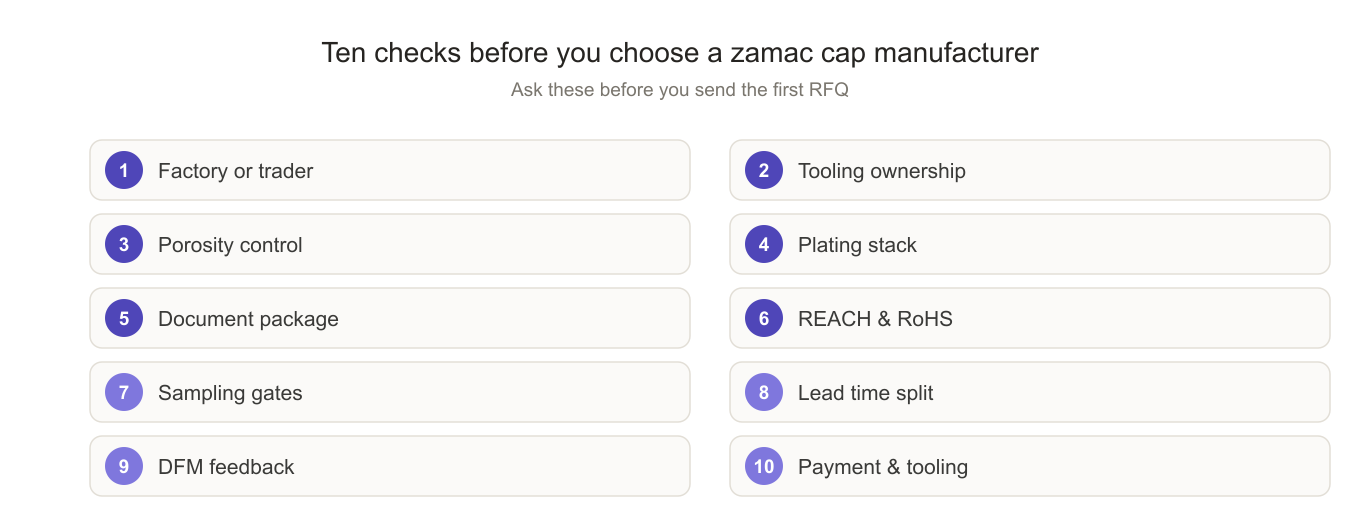
The ten checks at a glance
| # | Check | What to ask | Red flag |
|---|---|---|---|
| 1 | Factory or trader | Can I see the die-casting machines, the tool room and the plating line under one business licence? | Vague address, “our partner factory”, no machine list |
| 2 | Tooling ownership | Who builds the mould, who owns it, and is there a mould maintenance record? | Tooling subcontracted with no drawing control |
| 3 | Casting control | What is your porosity and dimensional control on a first article? | No FAI report offered |
| 4 | Plating control | Is plating in-house, and what is the full plating stack? | Only “we can do any colour” |
| 5 | Document package | Can you issue FAI, PPAP, RoHS and material certificates, control plan and COC? | Documents “available on request” with no sample copy |
| 6 | Compliance evidence | Can you support REACH and RoHS declarations for the EU, and Prop 65 for California? | Confuses RoHS with REACH |
| 7 | Sampling sequence | What are the gates between T1, range boards and the golden sample? | “We’ll send photos” |
| 8 | Lead time honesty | What is the tooling time, sample time and mass production time, separately? | One round number covering everything |
| 9 | Engineering feedback | Will you give DFM feedback on my drawing before quoting? | Silent quote with no comment |
| 10 | Commercial terms | What are the payment and delivery terms, and is mould cost one-off? | Re-charging tooling on reorder |
Checks 1–2: Factory status and tooling ownership
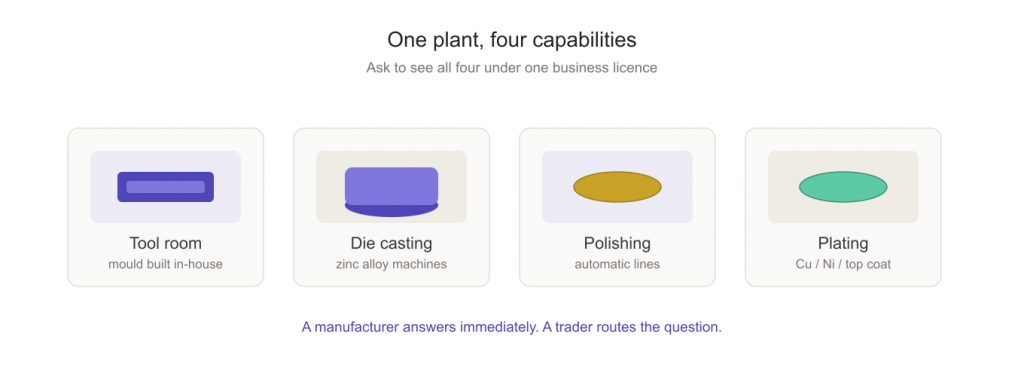
Start here, because everything downstream depends on it. A trading company can quote a metal cap; it cannot fix a porosity problem in week three.
Ask for three things in the first exchange: the business licence with a manufacturing scope, the plant address that matches the licence, and a machine list that covers zinc alloy die casting, CNC turning, polishing and plating. A genuine manufacturer answers all three without a meeting. If the answer is “our partner factory handles that”, you have learned something important: there will be a markup and a delay between you and every decision.
Tooling ownership is the second half of the same question. Ask three specific things:
- Who builds the mould — an in-house tool room means your design changes are a conversation, not a purchase order to a third party.
- Who owns it — the tool should be yours, paid for once, and not re-charged when you reorder. Get that in writing.
- How it is maintained — a mould used across a season picks up wear. Ask who pays for refurbishment and what the expected mould life is in shots.
A supplier that owns its tooling will also give you something more useful than a price: DFM feedback. Shrinkage, draft angle, parting line placement and wall thickness all change the tool before a single shot is cast. This is why a custom bottle cap project runs faster when engineering is in the same building as the tool room.
Reference point, stated plainly: we are a manufacturer, not a trader — zinc alloy die casting parts are made in our own plant, and the FAQ page answers the ownership and tooling questions directly, including that you do not pay mould cost again on reorder.
Checks 3–4: Casting and plating control
Zinc alloy die casting is a mature process, and that is exactly why weak suppliers survive: the process looks easy until you need 50,000 identical pieces in three finishes.
Casting. Two questions separate the capable from the hopeful. The first is how they control porosity — subsurface gas voids that only reveal themselves after polishing and plating, when the surface blisters and the part is already finished. The second is how they hold casting consistency across a shift and across a re-order. Ask what is measured, how often, and on how many pieces per lot.
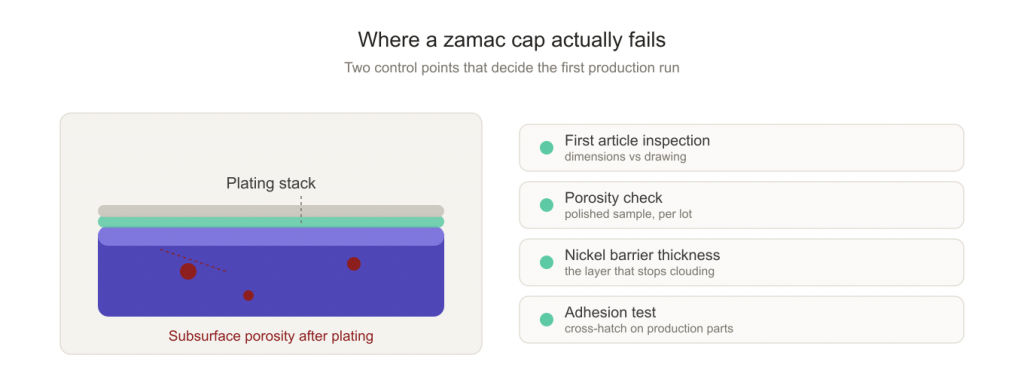
Plating. Ask for the full stack, not the colour name. Decorative zamac is plated copper → nickel → decorative top coat, and the nickel layer is the barrier that keeps moisture and alcohol off the zinc substrate. A thin nickel layer is the usual reason a cap clouds six weeks into retail. If the closure will touch spirits, ask how the surface coatings are tested — salt spray, alcohol immersion and cross-hatch adhesion on production parts, not on lab coupons.
A supplier that runs both casting and finishing in-house can trace a defect to the right step. A supplier that subcontracts plating will spend two weeks deciding whose fault it is.
Checks 5–6: Documents and compliance evidence
This is the check most buyers skip, and the one that hurts most landing. Ask for a sample copy of the document package before you place an order. For a metal closure going into the EU or US market, you should expect:
- FAI report (first article inspection) — dimensional results against your drawing
- PPAP / control plan — process documentation for repeat orders
- RoHS declaration and material certification for the alloy and the plating chemistry
- COC (certificate of conformance) with the shipment
Those four are not premium add-ons; they are the minimum evidence that a part was made and checked the way the drawing says. Ask whether regulatory standards for your target market are handled as standard paperwork or as a special request — the answer tells you how often they have shipped there.
Note on honesty: no two projects have the same compliance scope, and any supplier quoting a blanket “fully certified” without asking which market you sell in is guessing. Give your destination markets up front.
Checks 7–8: Sampling sequence and honest lead times
A professional sampling sequence has gates, and you should be told what they are:
- 3D render — the design intent, checked before any steel is cut
- T1 sample — the first parts off the tool, for fit and geometry
- Range boards — finish options on production parts, signed off together
- Golden sample — the agreed reference, sealed and held by both sides
If a supplier offers to skip straight to mass production, decline. The entire cost of a bad first run is a container, not a sample.
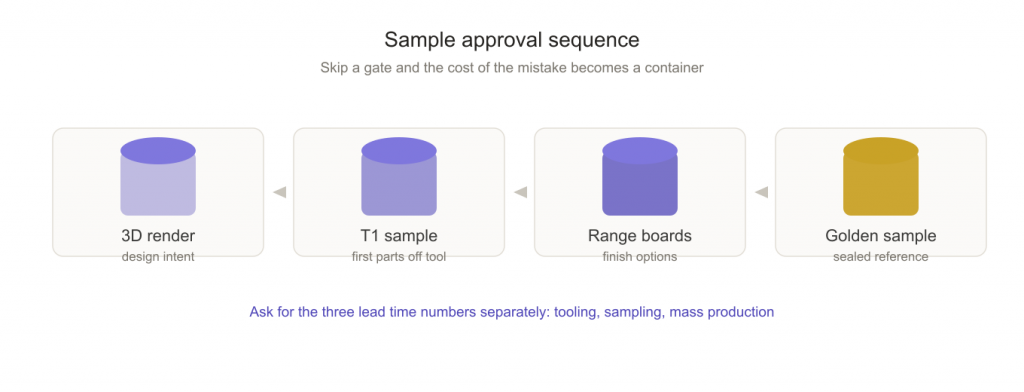
On timing, ask for three numbers separately: tooling time, sampling time, and mass production time. A single round figure covering all three hides the risk. On our side, custom samples run about 15 days and mass production about 25–30 days once the tool is signed off, and tooling itself is quoted and scheduled per project. Combine that with the MOQ, tooling and lead time guide before you set a launch date — MOQ for a custom zinc alloy closure is quoted per design rather than published as a fixed number, because it moves with geometry, finish and plating lot minimums.
Checks 9–10: Engineering feedback and commercial terms
The ninth check costs nothing and predicts the most. Send a drawing with one deliberate weakness — a wall that is too thin, a recess too deep to polish, a thread that will not release from the tool. A good supplier comes back with a marked-up drawing and a reason. A weak supplier returns a price and a promise.
You want the supplier that argues with you early. It is much cheaper than a tool modification later.
Finally, close the commercial loop before you sign anything:
- Payment terms — standard practice is T/T in advance, with net 30 available for established accounts. Ask early, because it affects your cash plan more than the unit price does.
- Delivery terms — FOB and CIF are both workable; pick the one that fits your freight setup rather than the one that looks cheaper.
- Tooling terms — confirm in writing that mould cost is one-off and that the tool is maintained for the life of the programme.
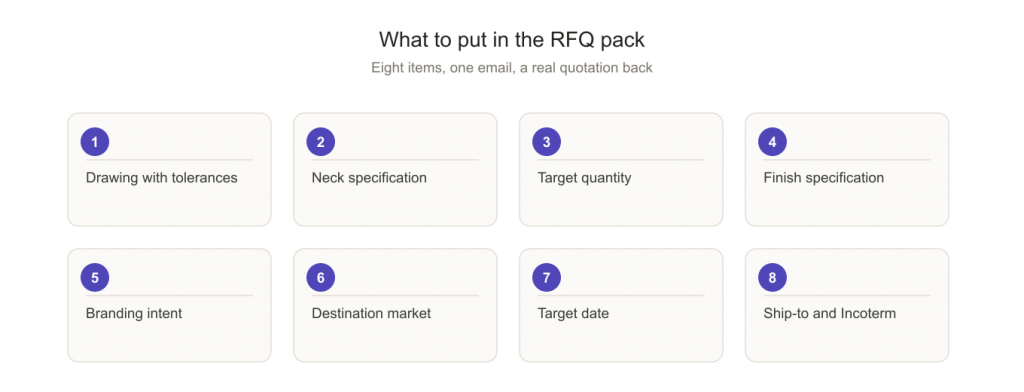
What to put in the RFQ pack
A complete RFQ gets a usable quotation in days. An incomplete one gets a guess, followed by a revision. Send:
- Drawing — 2D with tolerances on the critical fit dimensions, plus the 3D file if you have it
- Neck or vessel specification — the FEA 15 / 18.5 / 21.5 mm standard, or your own drawing of the mating part
- Target quantity — first order plus estimated annual volume; the tooling recommendation depends on both
- Finish specification — colour references, target gloss level, and any PVD requirement
- Branding intent — whether the mark is embossed, debossed, laser engraved or infilled
- Destination market — drives the compliance scope and the document package
- Target date — so the supplier can tell you honestly whether it is achievable
- Ship-to and Incoterm preference
If you do not have a drawing yet, say so. Most manufacturers can take a reference photo or a sketch to a perfume cap proposal and then to 3D — the honest answer is that this adds a design step, and you should plan it in rather than discover it.
FAQ
How do I know if I am talking to a factory or a trading company? Ask for the business licence with a manufacturing scope, the plant address that matches it, and a machine list covering die casting and finishing. A manufacturer answers immediately; a trader routes it. Cross-check the company name on the quote against the one on the licence.
What documents should a zamac cap manufacturer be able to issue? At minimum: FAI report, PPAP or control plan, RoHS and material certification, and a COC with each shipment. Ask for sample copies before ordering — the way a supplier produces them tells you how routine they are.
How long does custom zamac cap development take? Budget in three parts: tooling time quoted per project, custom samples around 15 days, and mass production around 25–30 days once the tool is signed off. Plan backwards from your launch date and keep a buffer.
Do I pay for the mould again when I reorder? You should not. Tooling is a one-off investment and the tool should be maintained for the life of the programme — get this in writing on the first PO.
What information do I need before requesting a quote? A drawing with tolerances, the neck or vessel specification, target quantity and annual volume, finish and branding intent, destination market, and target date. Eight items, one email, and you get a real number back.
Can you tell me the MOQ before I share a design? MOQ for a custom zinc alloy closure is quoted per design — it moves with geometry, finish and plating lot minimums rather than sitting at a published figure. Share the volume you are planning and the supplier can tell you whether your quantity is workable and how to reach it.
Next step
Send a drawing — or a sketch and a reference photo — with your quantity, target finish and destination market. Our engineers return DFM feedback and a quotation within two working days, and tooling is built in our own tool room. Whether you need a metal stopper for wine bottle, a zamac candle lid or a ODM/OEM factory partner for an ongoing programme, the ten checks above are the same ones we expect you to ask.
GuanChengXin (GCX) — zinc alloy die casting manufacturer in Dongguan, China. In-house tooling, die casting, CNC, polishing, plating and assembly for fragrance, spirits and home fragrance closures.