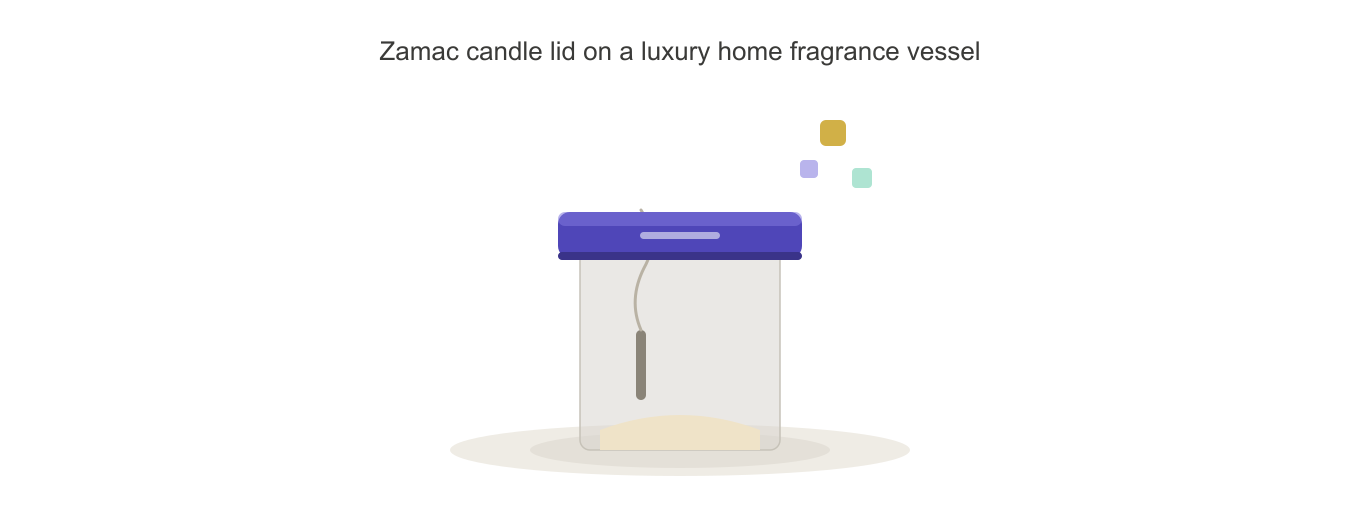
Zamac Candle Lids: Sizing, Finish and Custom Options for Home Fragrance Brands
The luxury candle aisle has quietly become one of the most competitive packaging categories in home fragrance. Walk past a premium counter and you will notice the same thing the fragrance buyers noticed a decade ago: the vessel is glass, the scent is invisible, and the object that communicates quality is the lid.
That is why more home fragrance brands are specifying zamac candle lid — a die-cast zinc alloy lid with the weight, the cold touch and the finish control that a wooden or tin lid cannot deliver. If you are evaluating one for the first time, the decisions are mostly the same as for a perfume cap, with three important differences: heat, wax, and fragrance oil.
Why zamac works on a candle vessel
Weight reads as value. Zamac has a density around 6.6 g/cm³, so a lid has real heft in the hand at a modest thickness. On a candle, weight is also functional — a heavier lid seals more consistently against the vessel rim.
Detail the way fragrance brands get detail. Die casting fills a steel mould under pressure, so an embossed crest, a monogram, a geometric relief or a fine guilloché pattern is formed in the metal rather than printed onto it. For a brand building a recognizable object rather than a disposable lid, this is the whole argument.
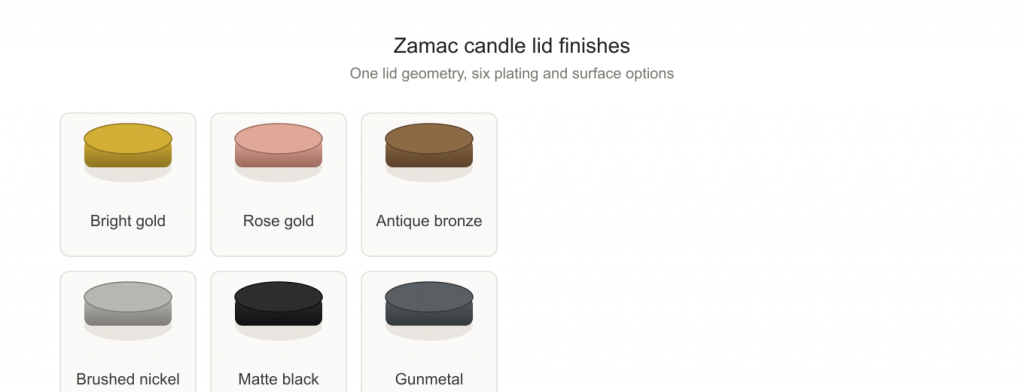
Finish control across a collection. Bright gold, matte black chrome, antique bronze, brushed nickel, rose gold, gunmetal. One lid geometry in three finishes gives you a seasonal or tiered collection without three tooling investments.
Thermal behaviour. Zamac melts in the region of 380–390 °C, far above anything a candle vessel rim reaches in normal use. That said, a metal lid is a storage and snuffing lid — it is not designed to sit on a burning candle. Design the product around that: the lid protects the wax surface, preserves the cold throw and closes the vessel between burns.
Three lid formats
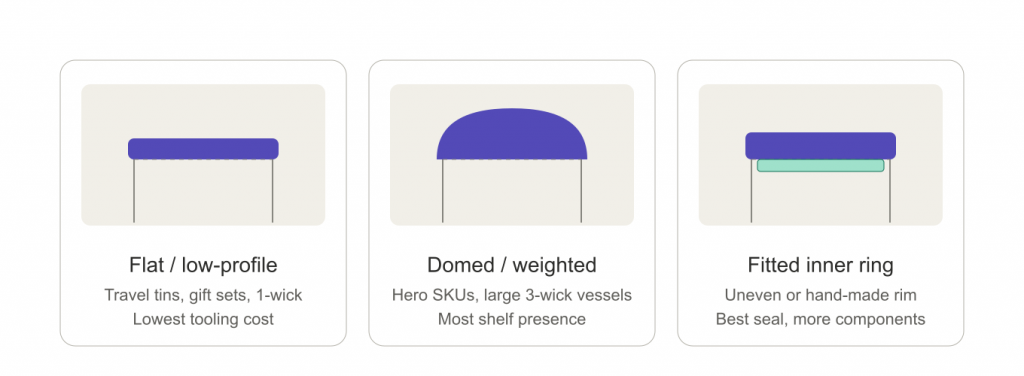
| Format | Construction | Best for | Notes |
| Flat / low-profile disc | Single die-cast disc, often with a rolled or bevelled edge | Minimalist vessels, gift sets, travel sizes | Most economical; logo by emboss or laser |
| Domed / weighted lid | Taller domed or faceted shell, heavier gauge | Premium and statement vessels, hero SKUs | More presence on shelf; higher weight cost |
| Fitted lid with inner ring | Zamac shell plus a food-grade liner or inner retaining ring | Vessels needing a tighter seal or a soft-close feel | Best seal performance; more components |
If your vessel has a wide, flat ground rim, the flat disc will seal well and cost least. If the rim is narrow or uneven — common on hand-made and recycled glass — the fitted lid with an inner ring is the safer engineering choice, because it tolerates rim variation instead of fighting it.
Sizing: measure the vessel, not the catalogue
This is where most first candle lid projects go wrong. Zinc alloy vessel diameters are quoted as nominal, and real glass varies.
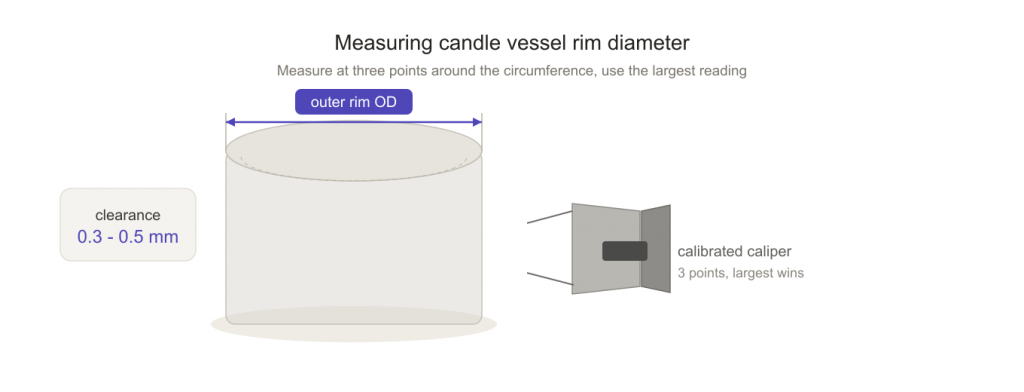
How to spec it:
- Measure the outer rim diameter of the vessel at three points around the circumference with a calibrated caliper, and use the largest reading.
- Measure the inner rim diameter if you are using an inner-ring or drop-in lid.
- Measure rim flatness — place the vessel on a surface plate and check for rock. An out-of-flat rim is the number one cause of a lid that rattles.
- Decide your clearance. For a slip-over lid, allow roughly 0.3–0.5 mm of clearance over the largest measured OD. Too tight and the lid jams or chips glass; too loose and it rattles in transit.
- Do a physical rattle test on T1 samples before approving.
| Vessel type | Common rim OD range | Recommended lid style |
| Travel / single-wick small | ~60–70 mm | Flat disc, low profile |
| Standard 2-wick | ~75–90 mm | Flat disc or shallow dome |
| Large 3-wick / statement | ~95–110 mm | Domed or fitted with inner ring |
| Diffuser bottle neck | 18.5 / 21.5 mm or FEA 15 mm | Zamac collar or stopper |
Reference ranges. Always confirm against a measured sample of your production vessel before tooling.
Finishes that survive wax and fragrance oil
Fragrance oil is a solvent, and it is in contact with the underside of the lid every time the candle is closed. Wax carry-over and condensation do the rest. A lid finish specified like a piece of jewellery will not last; a lid finish specified like a spirits closure will.
Specify all four:
- Barrier layers. Decorative zamac is plated copper → nickel → decorative top. The nickel is the barrier that keeps oil and moisture off the zinc substrate. A thin nickel layer is the usual cause of premature clouding and spotting.
- Final sealer. An e-coat or lacquer over the decorative layer is essential on a candle lid. It is what resists fragrance oil, fingerprints and the occasional wipe-down.
- PVD for high-touch SKUs. Physical vapour deposition is harder and more abrasion-resistant than standard electroplating. Worth the premium on a lid that will be handled repeatedly in retail.
- Testing. Ask for salt spray, fragrance-oil immersion, and cross-hatch adhesion results on production parts — not on lab coupons.
One design note: deep recesses collect wax and are hard to clean. If your branding uses a recessed logo, keep it shallow or specify epoxy infill so the recess is filled flush.
Branding options
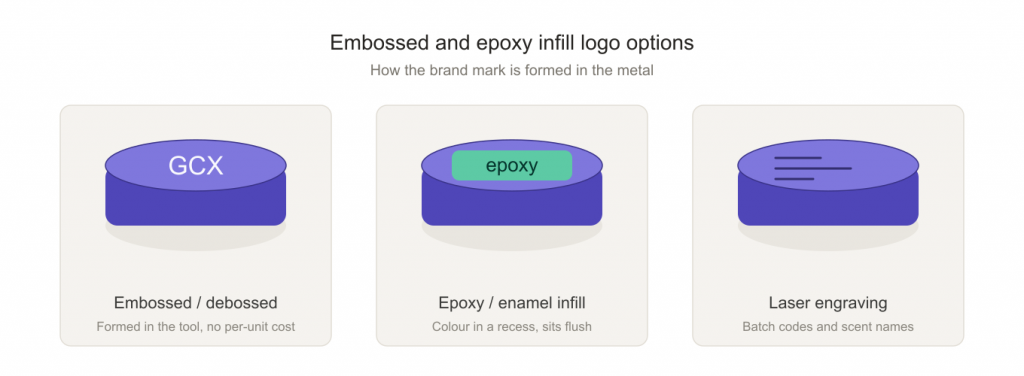
- Embossed or debossed monogram — formed in the tool, no per-unit decoration cost, survives handling best.
- Laser engraving — good for batch codes, scent names and limited-edition numbering.
- Epoxy dome or enamel infill — colour into a recessed mark; strong contrast on antique finishes and it solves the wax-collection problem.
- Antique / two-tone — dark patina in the recesses against polished high points; this is how a simple geometry gets depth without extra components.
- Sandblast with polished bevel — currently the most requested combination in premium home fragrance.
- Zamac nameplate insert — a small cast plate set into a wooden or ceramic lid. Useful if your brand voice is natural-material led but you still want a metal mark.
MOQ, sampling and lead time
A custom zamac candle lid follows the same production logic as a perfume cap:
- MOQ typically around 3,000–5,000 pieces for a fully custom geometry, driven by die-cast setup, plating minimum lot and polishing line changeover. Lower launch quantities are usually possible by adapting an existing tool.
- Sampling runs 3D render → T1 sample → range boards → signed golden sample. Always test the T1 lid on your production vessel, not a nominal one.
- Lead time is roughly 10–14 weeks for a first order (tooling ~25 working days, sampling ~15 days, mass production 25–30 days), and 4–6 weeks for a repeat order on an existing tool.
Plan the tooling backwards from your seasonal launch date and add a buffer. Home fragrance calendars are unforgiving — a lid that misses the autumn drop waits a year.
One tool, three product lines
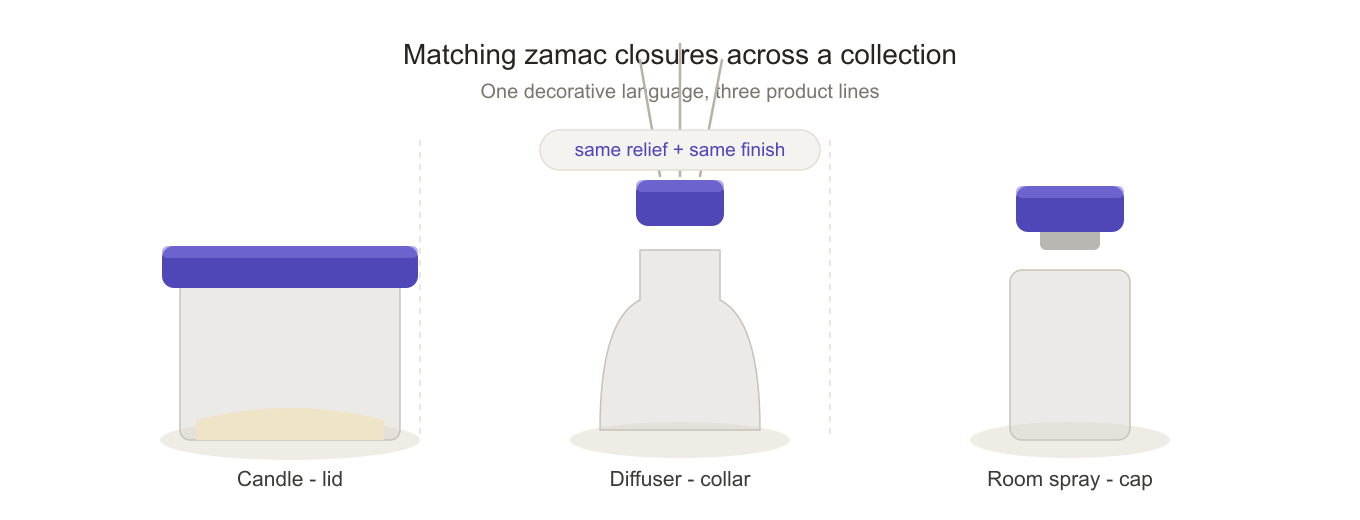
The argument that usually closes the business case: a zamac lid geometry is not locked to candles.
Many home fragrance houses run a candle, a reed diffuser and a room spray under the same brand. A single decorative language across all three — same relief pattern, same finish, the lid on the candle, a collar on the diffuser neck, a cap on the spray — is what makes a shelf set read as one house. And because the tooling is shared or closely related, the second and third applications cost a fraction of the first.
If you are developing a collection rather than a single SKU, brief the whole family at once. It changes the tooling recommendation and it usually lowers the per-unit cost across every line.
The 18-point RFQ checklist
very line you leave blank costs about a week of clarification email with your zamac cap manufacturer. Below is the full list in plain text — copy it straight into an email, fill in the blanks and send it with your drawings. If you would rather send a filled-in form, use the spreadsheet below.
Product
- Application — perfume / wine / spirits / candle / other: ______
- Bottle or vessel supplier, plus neck finish drawing (PDF): attached? ______
- Neck spec — FEA 15 / FEA 13 / 18.5 mm / 21.5 mm / other: ______
- Closure type — friction / magnetic / threaded / screw / dropper: ______
- Target weight: ______ g
- Alloy grade — Zamak 3 / Zamak 5 / please advise: ______
Design
- 2D drawings (PDF/CAD): attached? ______
- 3D file (STEP / IGES / STL): attached? ______
- Logo method — emboss / deboss / laser / epoxy infill / print: ______
- Finish: ______ (Pantone reference or physical sample attached? ______)
- Special process — antique / PVD / sandblast / two-tone / other: ______
Commercial
- Target quantity per SKU: ______
- Number of SKUs / finishes: ______
- Estimated annual volume: ______
- Incoterm — FOB / EXW / CIF / DDP: ______
- Destination market(s): ______
- Compliance documents required — REACH / RoHS / Prop 65 / FDA / EU 10/2011 / other: ______
- Target delivery date: ______
Download the fill-in version: GCX_RFQ_Spec_Sheet.xlsx
FAQ
Are zamac candle lids safe to use on a burning candle? They are designed as storage and snuffing lids — used to close the vessel between burns and to protect the wax surface. Zamac melts well above normal vessel rim temperatures, but the lid should be removed while the candle is lit.
How do I know what size lid my vessel needs? Measure the outer rim diameter at three points with a caliper and use the largest reading, then allow roughly 0.3–0.5 mm clearance. Catalogue dimensions are nominal; real glass varies, so always approve against a physical sample.
Will the finish survive fragrance oil? Yes, if the plating stack is specified for it — an adequate nickel barrier plus a final e-coat or lacquer seal. Ask for fragrance-oil immersion and adhesion test results on production samples.
Can a zamac lid be matched to our existing perfume cap? Yes. Matching the relief pattern and finish across a candle lid and a fragrance cap is a common brand-extension request, and running both from one finish specification is the reliable way to get them to match.
What is the MOQ for a custom candle lid? Typically around 3,000–5,000 pieces for a fully custom geometry. Adapting an existing tool usually opens up lower launch quantities.
Can you add our logo? Embossed, debossed, laser engraved, or epoxy/enamel infill — depending on the finish and where the mark sits. Deep recesses are best avoided or infilled because they collect wax.
Next step
If you are developing a custom zamac candle lid — or a full home fragrance family across candle, diffuser and room spray — send your vessel drawing, rim measurements and target quantity. We return DFM feedback and a quotation within two working days, and our in-house tool room delivers moulds in about 25 working days.
Get a Quote → | View zamac candle lid →
GuanChengXin (GCX) — zinc alloy die casting specialist, Dongguan, China. In-house tooling, die casting, polishing, plating and assembly for fragrance, spirits and home fragrance closures.