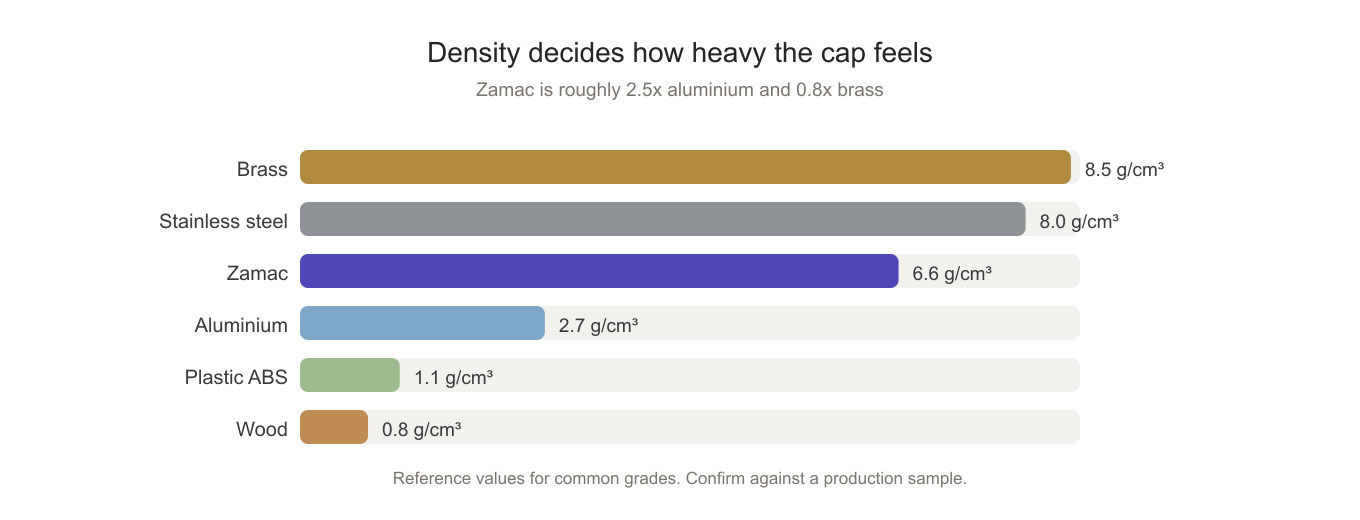
Ask five packaging suppliers what the cap should be made of and you will get five answers, each defending whatever that supplier happens to run. The honest version of this comparison of zamac perfume caps is not about finding a winner — it is about matching three things you already know: how much detail the design needs, how heavy the object should feel, and what the volume can carry in tooling and unit cost.
Below is the matrix buyers actually use, followed by material-by-material notes and a decision rule you can apply in one meeting.
The matrix
| Property | Zamac (zinc alloy) | Brass | Aluminium | Plastic (ABS / Surlyn) | Wood |
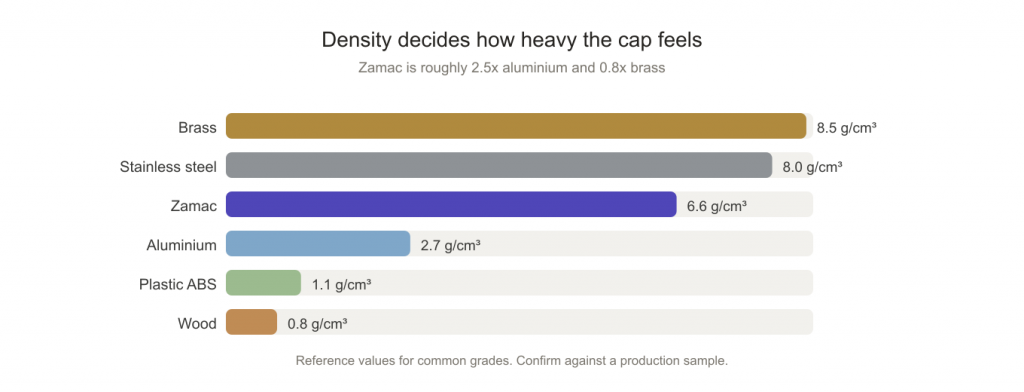
| Density (g/cm³) | ~6.6 | ~8.4–8.7 | ~2.7 | ~1.0–1.2 | ~0.6–0.9 |
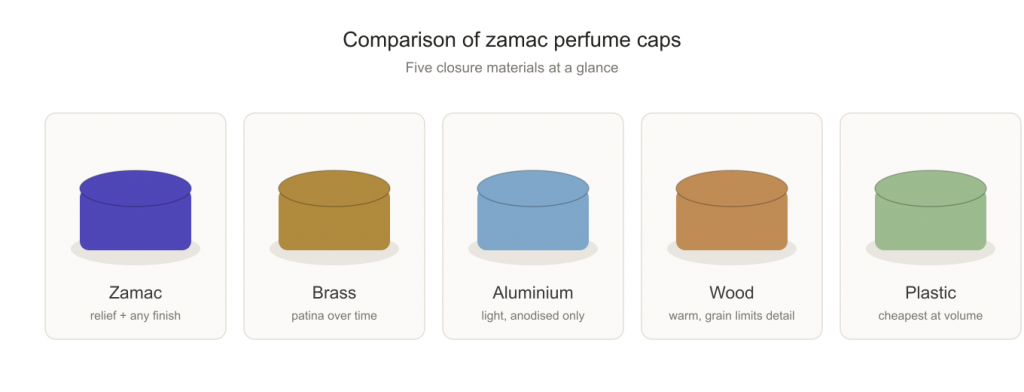
| Weight in the hand | Heavy, cold | Heaviest | Light | Very light | Light, warm |
| Forming process | High-pressure die casting | Die casting / CNC | CNC / extrusion + machining | Injection moulding | Turning / CNC |
| Detail fidelity | Excellent — relief forms in the tool | Very good | Good | Moderate — sink and witness marks | Poor — grain limits fine relief |
| Tooling cost tier | Medium–high | Medium (mostly machining) | Medium | High volume only justifies steel tools | Low |
| Unit cost tier | Medium | High | Medium | Lowest at scale | Medium–high |
| Typical MOQ tier | Quoted per design | Medium | Medium | High | Medium |
| Finish range | Widest — plating, PVD, lacquer, epoxy infill | Plating, antique patina | Anodising only | Moulded colour, soft-touch | Oils, stains, lacquer |
| Recyclability | Recyclable metal stream | Recyclable metal stream | Recyclable metal stream | Downcycled | Renewable, downcycled |
| Typical use | Luxury fragrance, spirits closures | Heritage spirits, limited editions | Spray collars, lightweight caps | Mass market, secondary closures | Diffuser collars, craft spirits |
Reference values for common alloys and grades. Confirm against a production sample before specifying.
What a material comparison should actually measure
Most comparisons stop at “zamac is heavier than aluminium”. Useful comparisons measure seven things:
- Detail fidelity — can the process reproduce the relief your design is built on?
- Weight and thermal feel — cold metal reads as value; light plastic reads as mass market.
- Dimensional repeatability — can the process hold the fit tolerance over 50,000 pieces?
- Finish range — how many finishes are available, and do they survive alcohol and fragrance oil?
- Tooling economics — what does the tool cost, and at what volume does it pay back?
- MOQ reality — what is the smallest workable run, and why?
- End of life — what you are allowed to claim in the EU and US markets.
If a supplier can only discuss item 1, they are describing a process, not advising on a specification.
Zamac — the reference material
Everything else in this table is measured against it, and with good reason: high-pressure die casting fills a steel tool with molten zinc alloy, which means an embossed crest, a monogram, a guilloché pattern or a faceted edge is formed in the metal rather than printed onto it. That single property is why designers choose zinc alloy when the cap carries the brand rather than just closing the bottle.
At roughly 6.6 g/cm³, a zamac cap has genuine heft without the cost of brass, and it takes the widest finish range in the table — bright gold, matte black chrome, antique bronze, brushed nickel, rose gold, gunmetal, plus PVD for high-touch surfaces and epoxy infill for colour in a recess.
The economics are the honest trade-off: tooling is a real investment and MOQ is quoted per design, driven by die-cast setup, plating lot minimums and polishing changeover. Above that threshold, the per-unit cost is competitive with machining and the detail is better than anything else at the price.
Choose it when: the cap carries the brand, the design has relief or fine detail, and volume clears a tooled minimum.
Brass — the heritage option
Brass is the heaviest and most expensive common closure metal, and it carries a warm tone that plating cannot quite imitate. It machines beautifully, takes a genuine patina rather than a simulated one, and it is the default for heritage spirits limited editions where the customer is expected to keep the object.
The constraints are cost and lead time. Brass is usually cut rather than cast for low volumes, which means machine time dominates the unit price. Detail is good but not equal to die casting — a fine relief that forms in one shot in zamac has to be cut feature by feature in brass.
Choose it when: the story is heritage and patina, the SKU is a limited edition, and the unit cost can carry machining time.
Aluminium — light and single-finish
Aluminium’s advantage is weight: at ~2.7 g/cm³ it is roughly 40% of the density of zamac. For larger closures where shipping weight matters, or for spray collars where heaviness is a functional nuisance, that matters.
The real limitation is finishing. Aluminium is essentially anodised, and while anodising gives durable, attractive colour, it is one finish family rather than the broad plating palette available on zinc. Deep relief that die casting handles easily has to be machined or forged, which erodes the cost advantage. There is a dedicated aluminium alloy perfume cap breakdown for buyers comparing the two seriously.
Choose it when: weight drives the decision, the geometry is simple, and one anodised family covers the whole collection.
Stainless steel — durable and expensive
Stainless solves problems the others do not: it is corrosion-resistant without plating, it cannot chip a decorative layer, and it accepts a mirror finish that reads as technical rather than luxury. It is also the slowest to machine and the most expensive per piece, which restricts it to premium spirits closures and refill systems where the cap is reused for years.
Choose it when: the closure is part of a refill system, corrosion resistance must come from the substrate, and the programme can carry CNC cost.
Plastic and wood — the two outsiders
Plastic caps win on unit cost at volume and lose on every sensory measure: they are light, they show sink marks and witness lines, and no amount of metallisation reproduces the cold feel of metal. They are the right answer for mass-market secondary closures and sample vials, and the wrong answer for a hero SKU.
A wooden perfume cap is genuinely renewable and warm to the touch, and it suits craft spirits and aromatherapy lines. It also has grain direction — fine monograms and sharp edges are unreliable — it moves with humidity, and finish options are limited to oils, stains and lacquers.
Choose plastic when: unit cost dominates and the closure is secondary. Choose wood when: sustainability messaging and tactile warmth are the whole point, and the geometry is simple.
What it actually costs
Unit price is the number everyone asks for and the one least useful on its own. Two columns matter more:
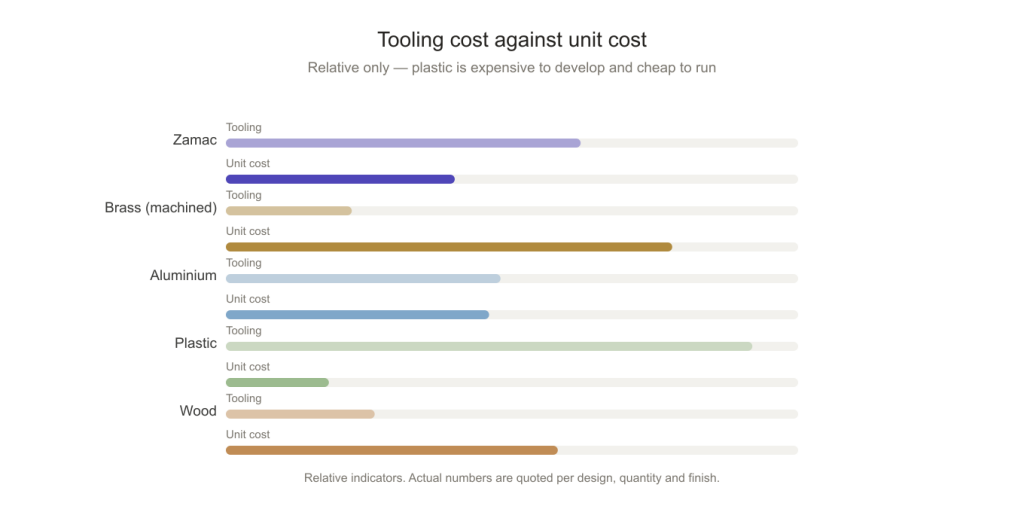
| Cost block | Zamac | Brass (machined) | Aluminium | Plastic | Wood |
| Tooling | Medium–high, one-off | Low tooling, high machine time | Medium | High for hardened steel | Low |
| Per-unit at low volume | Medium | High | Medium | High if tool cost not recovered | Medium–high |
| Per-unit at high volume | Low | High | Low | Lowest | Medium |
| Finish cost | Shared across the family | Often none required | One process | Minimal | Manual labour dominates |
Read it this way: plastic is cheapest per unit at scale and most expensive to develop; zamac has a higher entry cost and then scales well; brass never gets cheap because machine time never goes away. For the deeper breakdown of what moves the number — geometry, cavity count, finish layers, tolerances — see what drives the cost of custom zinc alloy perfume caps.
Finishes, and why the material limits them
Finish is where material choice becomes visible to the customer, and it is also where how many finishes a closure can carry becomes a real question. On zamac, the plating stack (copper → nickel → decorative top) plus sealer or PVD gives a wide and repeatable palette. On aluminium, anodising gives durable colour but within one family. On wood and plastic the palette is limited to coatings and moulded colour respectively.
If your collection needs one geometry in three finishes across seasons, only zamac delivers that from a single tool. That is an argument about total programme cost, not unit cost, and it usually decides the question. See surface treatment techniques for what each finish actually involves.
Decision rule
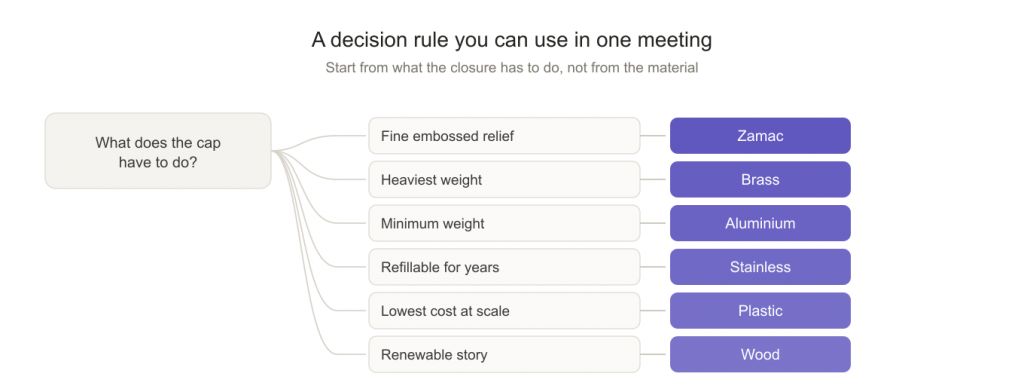
| If your priority is… | Choose | Because |
| Brand-carrying relief and fine monograms | Zamac | Detail forms in the tool, then takes any finish |
| Heaviest possible weight and patina | Brass | Warm tone develops over time instead of plating off |
| Minimum weight and shipping cost | Aluminium | ~40% of the density of zamac |
| Refillable / reusable for years | Stainless steel | Substrate-level corrosion resistance, no layer to chip |
| Lowest unit cost at very high volume | Plastic | Injection scale economics beat everything |
| Renewable story and tactile warmth | Wood | Grain and warmth are the message |
FAQ
Is zamac heavier than aluminium?
Yes, roughly two and a half times denser — about 6.6 g/cm³ against 2.7 g/cm³. In hand that reads as a solid, cold object rather than a light one, which is usually the intent on a premium cap.
Which material gives the sharpest embossed logo?
Zamac. High-pressure die casting forms relief in the metal; machining has to cut each feature, and injection moulding loses detail to sink and shrinkage.
What is the cheapest material for a perfume cap?
Plastic at very high volume, once the tool cost is recovered. At low-to-mid volumes, zamac is usually cheaper than machined brass and comparable to machined aluminium, with better detail.
Can one cap design run in several finishes?
Only zamac reliably does this from one tool — the geometry stays constant and the plating stack changes. That is why tiered collections are usually zamac.
Does the material change compliance requirements?
Yes. Metal caps need RoHS and REACH declarations for the alloy and plating chemistry, and California Prop 65 applies regardless of material. Give the supplier your destination markets when you specify.
Next step
Choosing a material is a specification decision, not a preference — and the fastest way to settle it is to put your design, quantity and finish intent in front of someone who runs the process. Send your drawing or reference photo and we will tell you honestly whether zamac, brass or aluminium is the right call for that part, including what it costs at your volume. If the project starts from a sketch rather than a drawing, begin with a custom bottle cap development step and specify material once you have seen the first renders.
Get a Quote → | View zamac perfume caps →
GuanChengXin (GCX) — zinc alloy die casting manufacturer in Dongguan, China. In-house tooling, die casting, polishing, plating and assembly for fragrance, spirits and home fragrance closures.