Zamac Closure Compliance for Wine and Spirits: REACH, RoHS, Prop 65 and Migration Testing
A custom metal closure rarely fails because of design. It fails in week six, when someone in regulatory asks one question the supplier cannot answer: what is actually in it, and can you prove it?
If you are specifying a zamac closure for wine compliance — or for spirits, spirits-adjacent liqueurs and premium RTD — this is the checklist that prevents that week-six phone call. It covers which regimes actually apply to a metal closure, which part carries the risk, and which documents to ask for before you place the order rather than after it lands.
The four regimes that actually apply
| Regime | Geography | What it touches on a metal closure | Document you should get |
|---|---|---|---|
| REACH (EC 1907/2006) | EU / EEA (and UK REACH separately) | Substances in the article; SVHC above 0.1% w/w; Annex XVII restrictions on nickel, lead, cadmium | REACH statement + SVHC screening report |
| RoHS (2011/65/EU) | EU — legally electrical equipment; requested for caps as a material declaration | Lead, cadmium, mercury, Cr(VI), certain flame retardants, phthalates | RoHS declaration + material certification |
| Food contact (EC 1935/2004 + (EU) 10/2011 for plastic parts) | EU | Any part touching the beverage — usually the liner or insert, not the metal shell | Migration test report + declaration of compliance |
| Prop 65 | California, US | Listed substances (lead, cadmium and others) above safe-harbour exposure levels | Prop 65 statement or a defensible testing basis |
Note what is not in that table: there is no single global “certificate for bottle caps”. What exists is a set of declarations and test reports, each answering one question. A supplier claiming blanket certification without asking where you sell is guessing.

EU: what an importer must be able to show
If you place zamac closures on the EU market, you are the one who has to answer questions — not the factory across an ocean. Three things matter:
REACH substance status. Zinc alloy itself is not the issue; the issue is everything else in the article — residual lead and cadmium in the alloy, and any restricted substance in the plating chemistry or coating. Ask for SVHC screening against the current candidate list and a written statement, not verbally over email.
Annex XVII restrictions. Two entries come up repeatedly for metal closures, and both deserve their own section below: nickel release and lead.
Documentation discipline. REACH obligations for articles sit with the producer or importer, so build the file before the shipment: alloy certification from the ingot source, plating chemistry documentation, and a declaration that names the regulation and the date.
The practical shortcut: ask the supplier to send last month’s certificate package rather than a promise. A manufacturer producing RoHS and material certification as routine paperwork will have it in minutes. If it takes two weeks and three follow-ups, you have learned how often they ship to regulated markets.
EU food contact: the liner is the risk, not the metal
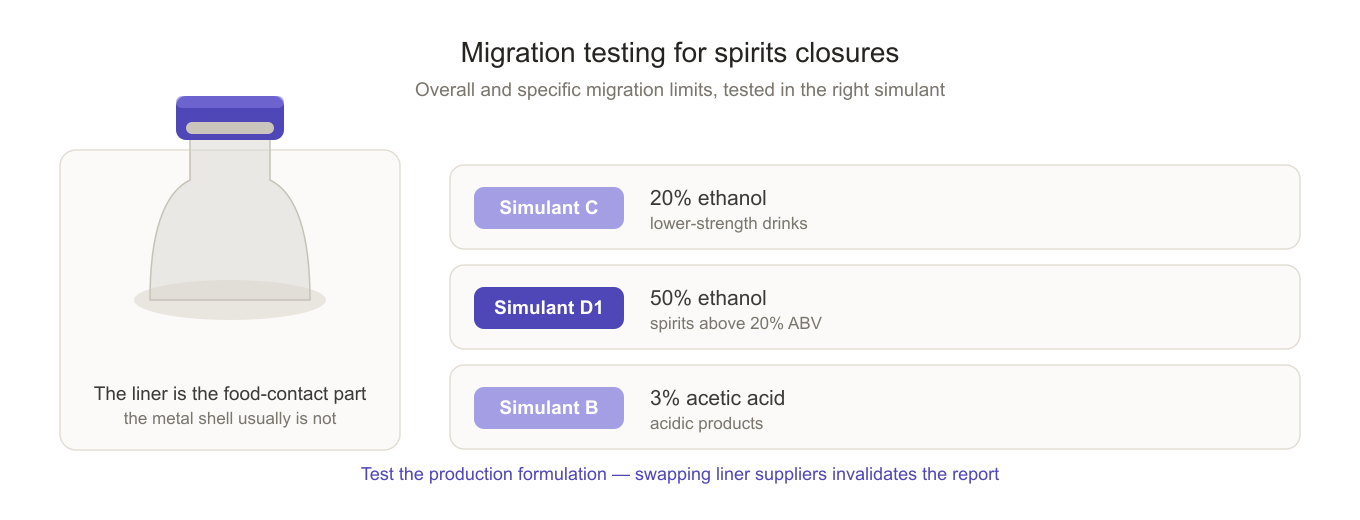
This is the part buyers get wrong most often. A zamac shell does not contact the beverage. The closure built into it does — usually an EVA, PE or TPE liner, sometimes a pourer insert or a plastic thread insert. Those components are plastic articles intended to contact food, and they carry the actual food-contact obligation.
For EU compliance you should expect:
- Framework declaration under Regulation (EC) 1935/2004 for every part intended to contact food
- Restrictions per (EU) 10/2011 for plastic layers — overall migration limit (OML) and specific migration limits (SML) per substance
- Migration testing in the correct simulants. For spirits above 20% ABV, simulant D1 (50% ethanol) is the relevant one; C (20% ethanol) is typically used for lower-strength products, alongside acidic simulant B where the product is acidic
- Traceability — batch-level documentation tying the tested material to the shipped lot
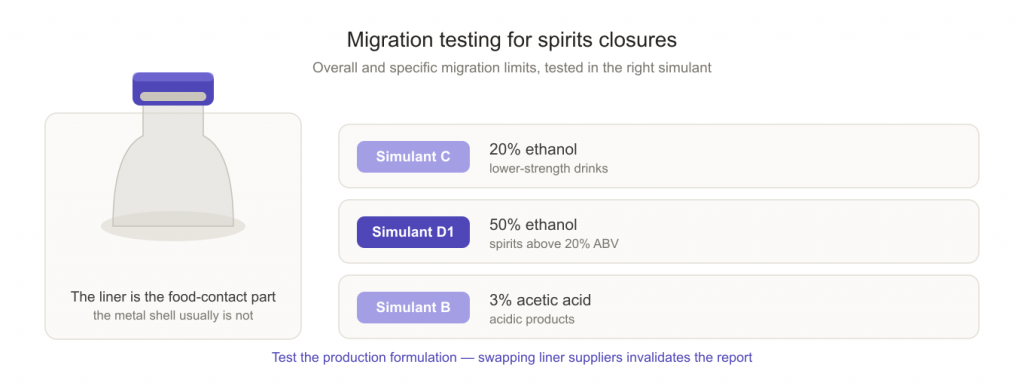
Two practical warnings. First, migration testing takes weeks and must run on the production formulation — swapping liner suppliers after testing invalidates the report. Second, ask whether the metal shell is lacquered or plated with anything that could migrate through the liner seam; the topcoat chemistry is part of the answer, which is why surface coatings belong in the compliance file, not just the design brief.
United States: FDA expectations plus Prop 65
US requirements split into two different questions.
Food contact (FDA). Any component intended to contact a beverage must be made from materials cleared for that use — either appearing in the applicable FDA food-contact regulations or supported by a food-contact substance notification or a prior sanction. For a spirits closure, that means the liner and any insert must come with a food-contact statement naming the clearance. Metal components generally satisfy food-contact expectations through compositional declarations for the alloy and plating.
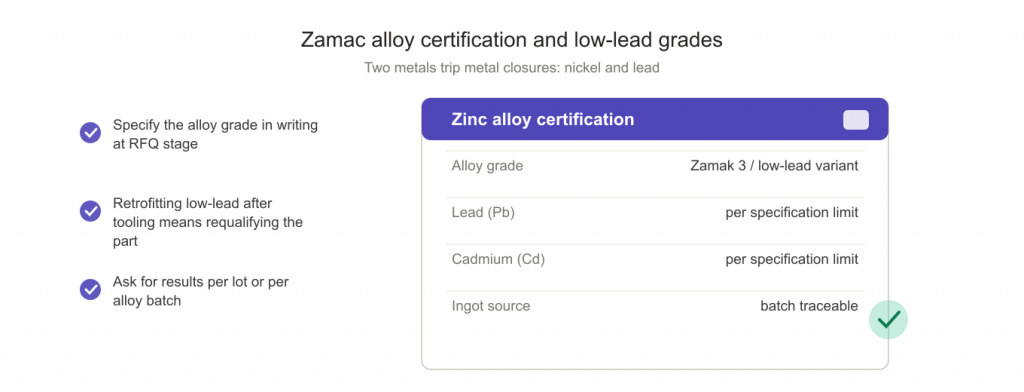
Proposition 65 (California). Entirely separate from food-contact law. If a listed substance is present above an applicable safe-harbour level and exposure is not adequately controlled, a warning may be required. For metal closures, lead and cadmium in the alloy are the usual focus. This is where alloy composition matters: specify low-lead zinc alloy grades from the start rather than discovering the issue after tooling, when changing the specification means requalifying the part.
Ask prophetically but plainly: which alloy grade, which lead and cadmium limits, and can you show test results per lot or per alloy batch?
Nickel and lead: the two that trip metal closures
Nickel — REACH Annex XVII, entry 27. Applies to articles in prolonged contact with the skin. A decorative outer cap that a consumer handles briefly is usually outside this restriction, but anything worn against skin, handled repeatedly in a way routine enough to be classed as prolonged contact, or designed as a keepsake should be assessed. The limit is expressed as nickel release per unit area per week, measured by the harmonised reference method — not as total nickel content. Ask for a release test, not a composition statement, when the article is in scope.
Lead — REACH Annex XVII entry 63, plus Prop 65 in the US. Restrictions on lead take different forms depending on the article category and whether it is a children’s product. In practice, two things protect you: specify a low-lead alloy grade in writing at RFQ stage, and ask for alloy certification tied to the ingot source. Retrofitting a low-lead requirement after samples is expensive because it can mean re-running producing parts and re-testing finishes.
The document package to request before you order
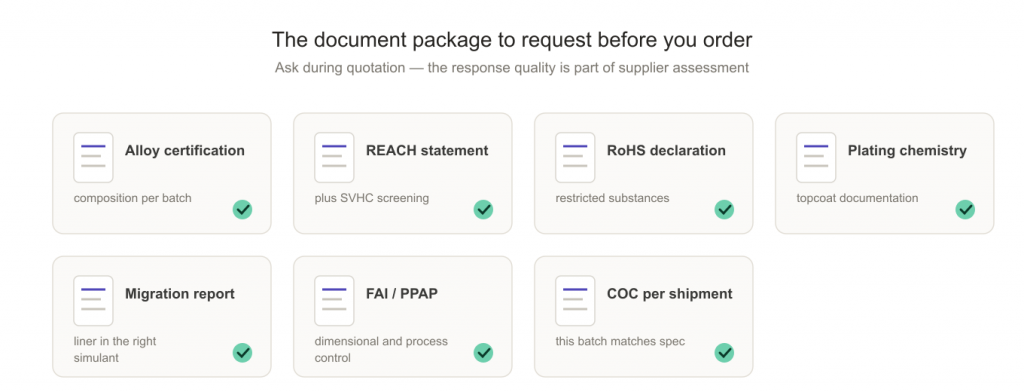
Do not wait until the shipment. Ask for the package during quotation and treat the response quality as part of your supplier assessment:
| Document | What it proves | Who needs it |
| Alloy certification (ingot source) | Composition of the zinc alloy, including lead and cadmium | EU and US importers |
| REACH statement + SVHC screening | No declarable SVHC above threshold | EU importers |
| RoHS declaration | Restricted substances within limits (often requested beyond its legal scope) | Most brand owners |
| Plating chemistry documentation | No restricted substances in the topcoat or barrier layers | EU and US importers |
| Migration test report on the liner | Overall and specific migration within limits for your simulant | Anyone whose closure touches beverage |
| FAI report / PPAP / control plan | Dimensional and process control for repeat orders | All programmes |
| COC with each shipment | This batch matches the approved specification | Everyone |
Standard-produced, regularly-shipped documentation is the cheapest insurance you will ever buy. Our own MOQ, tooling and lead time guide covers the commercial side of that same conversation.
One visible part sits upstream of the checklist. Specify low-lead alloy and durable finishing from the outset and the closure stays compliant at end of life as well: see eco-friendly perfume caps and the environmental impacts of various wine bottle cap materials for how recyclability and material choice interact.
Six questions to send your supplier today
- Which zinc alloy grade do you run, and what are its lead and cadmium limits?
- Can you send this month’s REACH statement and RoHS declaration as issued?
- Is plating done in-house, and can you document the plating chemistry?
- Is the liner food-contact compliant for my product’s alcohol strength — and tested in which simulant?
- Does my destination market change anything in your answer above?
- Which of the documents above ship with every order as standard?
A supplier that answers all six with documents rather than assurances will not cost you a season. One that answers with adjectives will.
FAQ
Do zamac closures need REACH compliance in the EU?
Yes — the article placed on the EU market must not contain SVHC above 0.1% w/w without the required communication, and must satisfy Annex XVII restrictions for substances such as nickel, lead and cadmium. Ask for a REACH statement plus SVHC screening rather than a general assurance.
Is RoHS applicable to a bottle cap?
RoHS is legally scoped to electrical and electronic equipment, so a plain metal cap falls outside it — but most brand owners still request a RoHS declaration as a material declaration because it covers lead, cadmium, mercury and Cr(VI). Expect it as a document even if not as a legal obligation.
Which part of a spirits closure carries food-contact obligations?
Usually the liner or insert — the component actually touching the beverage. It needs a declaration under (EC) 1935/2004 and, for plastic parts, restricted-substance compliance under (EU) 10/2011 with migration testing in the correct simulant.
What simulant should I test a spirits closure liner against?
For products above 20% ABV, the EU reference simulant is D1 (50% ethanol); lower-strength products typically use C (20% ethanol). Confirm with your testing lab based on your actual formulation and contact conditions.
Does Prop 65 apply if I only sell in Europe?
No — Prop 65 is a California requirement. It applies if you place the finished product into California commerce. If both markets are in scope, address them separately; they ask different questions.
Is any of this legal advice?
No. This guide describes what to request from a supplier so nothing stalls late in the project. Your regulatory counsel should confirm the exact scope for your product and markets before you finalise a specification.
Next step
Send your destination markets, product alcohol strength and target quantity with your RFQ, and we will return the document package that matches it — alloy certification, REACH and RoHS statements, plating chemistry documentation, and liner migration testing where applicable — alongside DFM feedback and pricing for zamac spirits bottle caps and custom zamac perfume caps.
GuanChengXin (GCX) — zinc alloy die casting manufacturer in Dongguan, China. In-house tooling, die casting, polishing, plating and assembly for fragrance, spirits and home fragrance closures.