A custom zamac cap is not approved by a photo, a feeling or a good phone call. It is approved at a series of gates — and the first of those gates, the T1 sample, is where a programme is either corrected cheaply or quietly set up to fail. The difference between a first production run that ships on time and one that costs you a season is decided weeks earlier, over a small number of metal parts that fit in an envelope.
This guide is written for buyers who are about to sample a custom closure and want a defensible standard for saying yes or no. It covers the sequence from first article to golden sample, what a T1 must actually prove, the approval checklist to run on the parts you receive, what our 15-day sampling window really covers, and what to send with your RFQ so the first sample is usable.
The sampling sequence at a glance
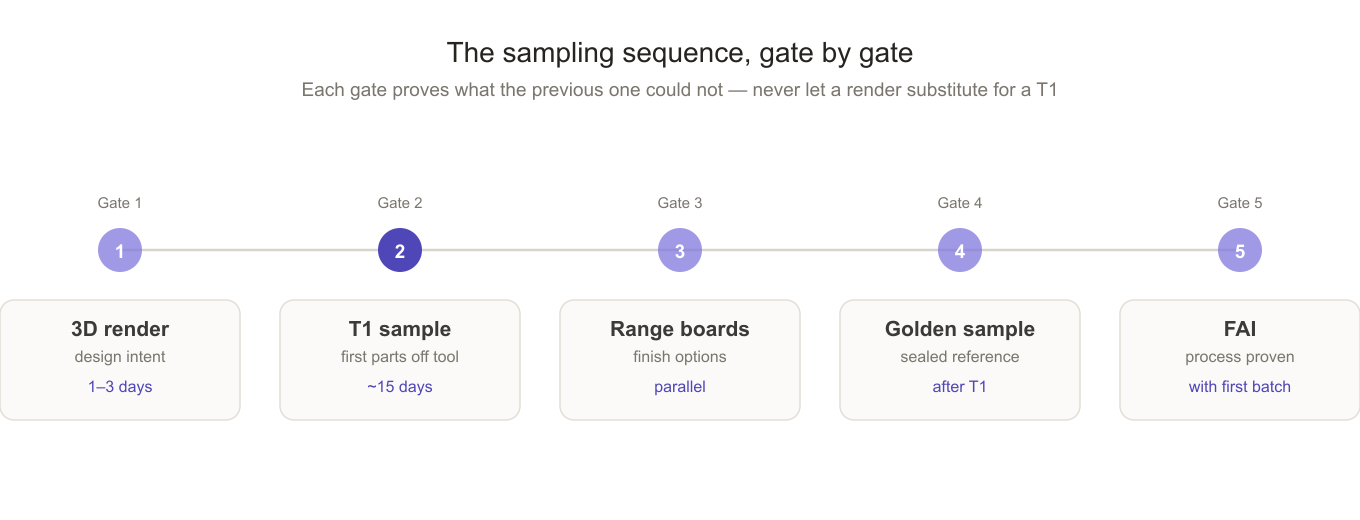
Sampling is not one event; it is a chain of gates, each proving something the previous one could not. When you vet a zamac cap manufacturer before you send an RFQ, ask them to walk you through this table — a factory that cannot describe its own gates will improvise them later.
| Gate | What it proves | Typical timing | Who signs it off |
|---|---|---|---|
| 3D render / print | Design intent, fit on your bottle, proportions | 1–3 days after drawing | Your marketing or packaging team |
| T1 sample | First parts off the real tool: material, dimensions, structure | After tooling is cut; our sampling window is about 15 days | Your engineering and quality contact |
| Range boards | Plating colour, finish level, polish grade options | Runs in parallel with T1 | Your brand or design team |
| Golden sample | The sealed reference every production lot is judged against | After T1 approval | Both sides, signed and dated |
| FAI / first production inspection | The production process can repeat the golden sample | With the first production batch | Your quality contact |
Two practical rules fall out of this table. First, never let a render substitute for a T1: a render proves the drawing was understood, not that the tool was. Second, the golden sample is the contract — when a later lot drifts, you compare against the golden sample, not against anyone’s memory of the approval email.
What a T1 sample must actually prove
A T1 sample that “looks right” has proved almost nothing. Run the parts against five questions, in this order:
- Material and finish stack. Is the alloy grade what you specified, and is the full plating stack present — copper strike, nickel barrier, top coat — in the stated thickness? A cap that is one layer short will pass a visual check today and blister in a humidity chamber next year.
- Fit and function on your bottle. Screw torque or snap retention, seal integrity if the closure seals, and the tactile “click” of a magnetic closure. Test on your production bottles, not on the factory’s reference bottle.
- Critical dimensions against your drawing. The three or four dimensions that decide assembly — neck bore, thread or snap profile, height. Ask for a measured report, not a verbal “it’s in tolerance”.
- Visible surfaces. Parting line placement, polish uniformity, plating colour against the approved range board. The parting line you can see from the front is a design failure, not a cosmetic detail.
- Repeatability. Ask how many parts were shot for your sample and whether they came from one cavity or several. A T1 from one lucky cavity proves the tool, not the process.
How to judge a T1 sample: the approval checklist
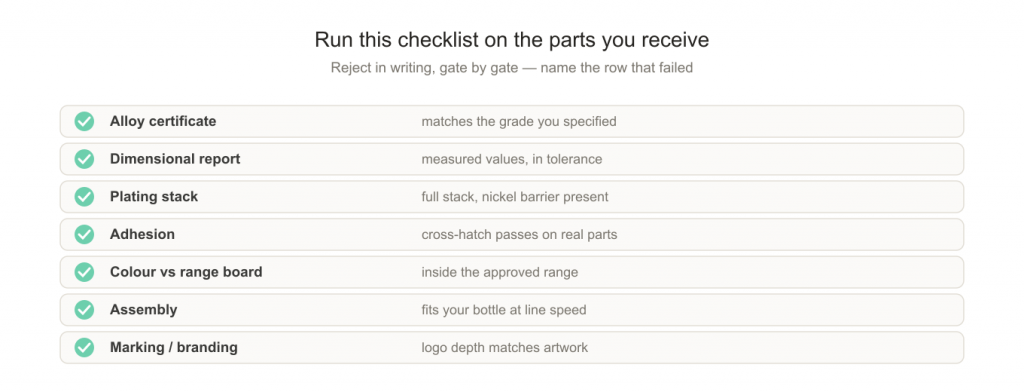
Print this table and run it on the parts you receive. Each row has a pass condition and the failure it catches.
| Check | Pass condition | Common failure it catches |
| Alloy certificate | Material certificate matches the grade you specified | Substituted or recycled alloy of unknown composition |
| Dimensional report | Measured values on your critical dimensions, within drawing tolerance | “Visual inspection” with no numbers |
| Plating stack | Full stack confirmed, nickel barrier present | Missing nickel barrier → later clouding and blistering |
| Adhesion | Cross-hatch or tape test passes on production-representative parts | Plating lifting at the parting line after assembly |
| Colour against range board | Sample sits inside the approved board range | Colour drift between sample and mass production |
| Assembly | Fits your bottle at your line speed, torque or retention in spec | Caps that strip or cross-thread on the filling line |
| Marking / branding | Logo depth, position and engraving match the approved artwork | Engraving depth that fills with plating and blurs |
Two rules about rejecting: reject in writing, gate by gate, naming the row of this table that failed; and ask for the corrected parts against the same golden-sample reference, so the revision is measurable. A supplier who answers a rejection with a new photo instead of new parts is not running a sampling process.
What 15 days of sampling actually covers
Our published sampling window is about 15 days — and it is worth being precise about what that covers, because most disputes about sampling lead time are really disputes about scope.
| Included in the 15 days | Not included — ask separately |
|---|---|
| Tool cutting and first-article production | Your own drawing freeze (the clock starts at a released revision) |
| Basic dimensional measurement and report | Extra plating trials beyond the approved range board |
| One round of standard plating options | Structural changes after T1 — those mean tool modification |
| Shipping of the sample set | Inbound transit and customs on your side |
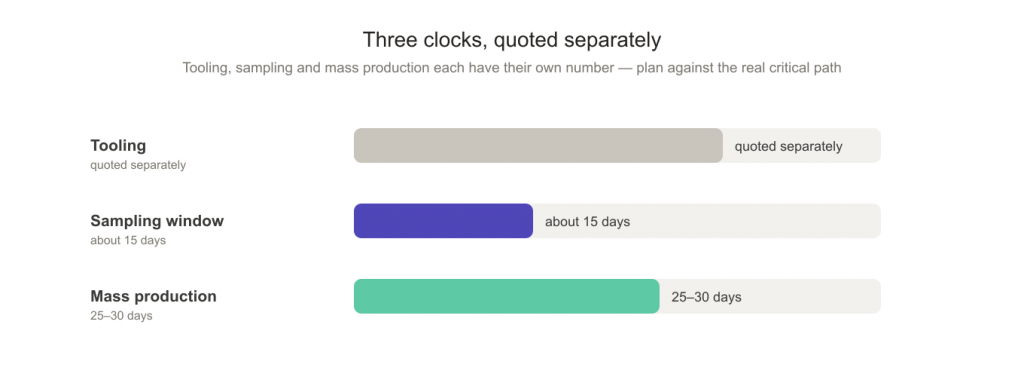
Three things extend the window, and they are worth knowing before you promise a launch date to your own team: a drawing revision after tooling has started, a plating colour outside the standard range, and waiting on your bottle or liner component to arrive for assembly testing. None of these are hidden charges — they are simply the moments where the clock pauses. For mass production after sampling, our standard window is 25–30 days, and tooling, sampling and production are quoted as three separate numbers so you can plan against the real critical path rather than one round figure.
What to send with your RFQ to get a usable first sample
The fastest way to a good T1 is to remove ambiguity from the request itself. Send these six items with the drawing and the first sample set is usable on arrival:
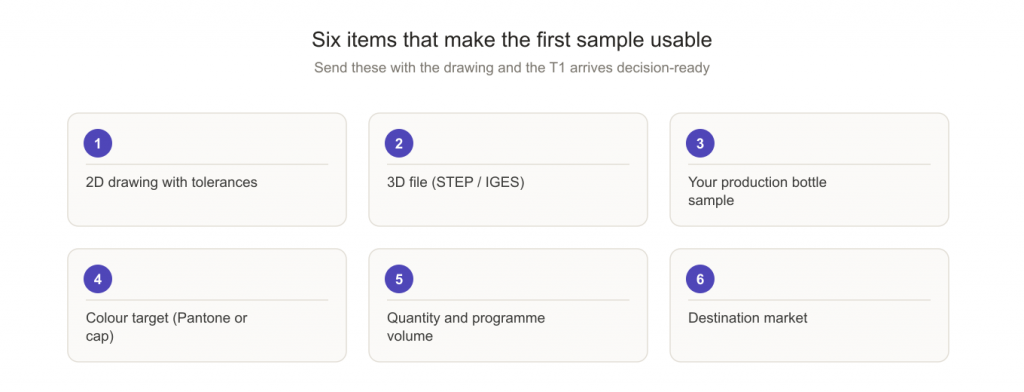
- 2D drawing with tolerances on the critical dimensions — or a sketch plus a reference photo if the drawing does not exist yet.
- 3D file (STEP or IGES) if you have one; it removes a week of interpretation.
- Your production bottle or neck sample — the single most useful item in the box.
- Colour target: a Pantone reference, a physical cap, or the range board you want matched.
- Quantity and programme context: sample quantity now, and your expected annual volume — it changes tooling strategy and the sampling plan.
- Destination market — because compliance scope (REACH, RoHS, Prop 65) is cheaper to design in than to retrofit, as our guide to closure compliance for wine and spirits explains.
If the material decision is still open — whether the cap should be zamak at all, or brass, aluminium, plastic or wood — read how zamak compares with brass, aluminium, plastic and wood first: sampling the wrong material twice is the most expensive mistake in this stage, and it is entirely avoidable.
Sample cost and how it applies to your programme
Sampling has a cost, and the honest question is not “is it free” but “what happens to the money”. Our policy is simple: the sampling fee is credited against your first production order. You are not paying twice for the same programme — the sample is a down payment on production, not a separate toll.
Ask every supplier the same four questions, whatever their policy:
- Is the sample fee quoted separately from tooling, and what does each cover?
- Is the sample fee credited against the first order — fully, or partly?
- What does a second sampling round cost, and when is it free (for example, when the first round failed our error)?
- Is tooling charged once, including reorders and spare moulds?
That last question matters more than buyers expect: a mould that is re-charged on every reorder turns a repeat order into a new project. At GCX tooling is charged once — reorders and spare moulds are not re-billed. For the wider commercial frame around MOQ, tooling and production timing, our sourcing guide to MOQ, tooling and lead time covers the rest.
FAQ
Ask for a set that includes parts from every cavity that will run in production, not one hero part. A single beautiful cap proves the tool; a cavity-matched set proves the process.
Only if your brand accepts the risk. Plating colour varies with bath chemistry, polish grade and base alloy; the range board exists so that “gold” means the same thing in sample and in production.
Reject in writing against the checklist above, and agree the rework terms before sampling starts — who pays for a correction round, and how the timeline re-starts, should be in writing rather than in anyone’s memory. That is what the gate structure is for.
Yes. It is the only artefact everyone can agree on when a lot drifts in month nine. Ours is signed, dated and sealed by both sides.
FAI on the first article, material and RoHS declarations, and a COC confirming the batch matches the approved specification — the same document pack described in our sampling and lead-time FAQ.
The 15 days covers production of the sample set. Transit is quoted separately per destination, FOB or CIF as you prefer.
Next step
Send your drawing, your bottle sample and your colour target with the quantity and destination market. Our engineers return DFM feedback and a quotation before tooling is cut, sampling is quoted as its own line item, and the fee is credited against your first production order. Whether the programme is a first fragrance launch or a repeat spirits order, the gates above are the ones we expect you to hold us to — and the same ones we run internally.
Browse the zamac perfume cap collection to see finishes and structures already in production, or read more about how we work as a custom zamac bottle caps manufacturer before you send the RFQ.