Magnetic vs Screw vs Snap-On Perfume Caps: Choosing the Right Closure
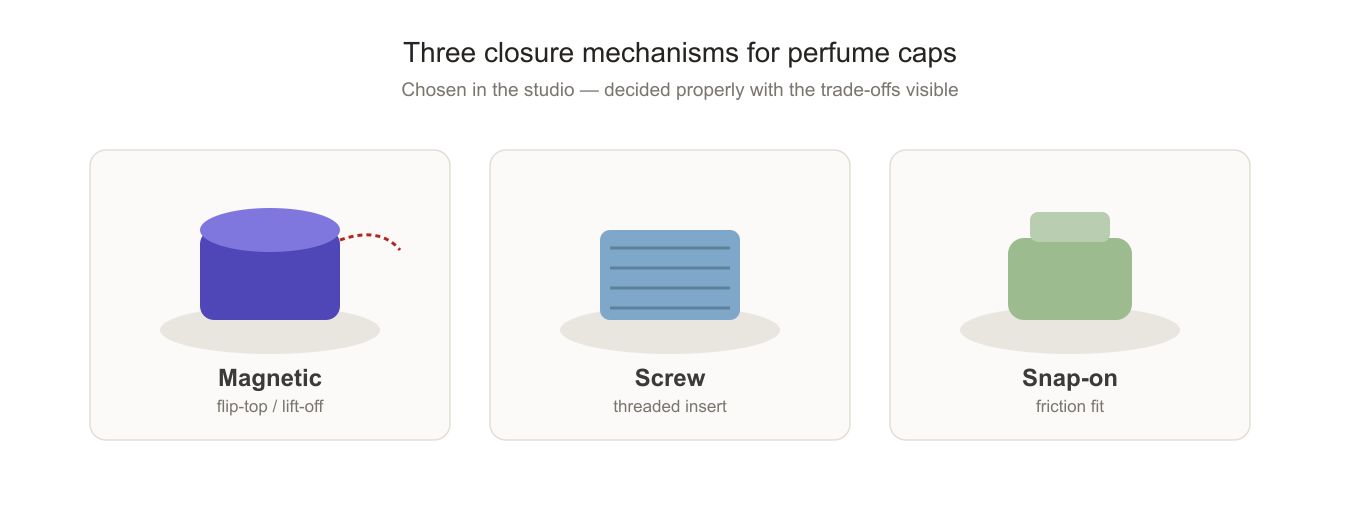
Ask a packaging team how their cap closes and you will hear “magnetic” long before you hear a millimetre. The mechanism is usually chosen in the design studio, for the feel of the unboxing, and locked in before anyone models the ergonomics, the bottle interface or the cost curve. That order of decisions is how programmes end up re-tooling at sample stage. This guide compares the three closure mechanisms that dominate custom perfume caps — magnetic, screw and snap-on — on the dimensions that actually differ, so the choice is made once, with the trade-offs visible.
The three mechanisms at a glance
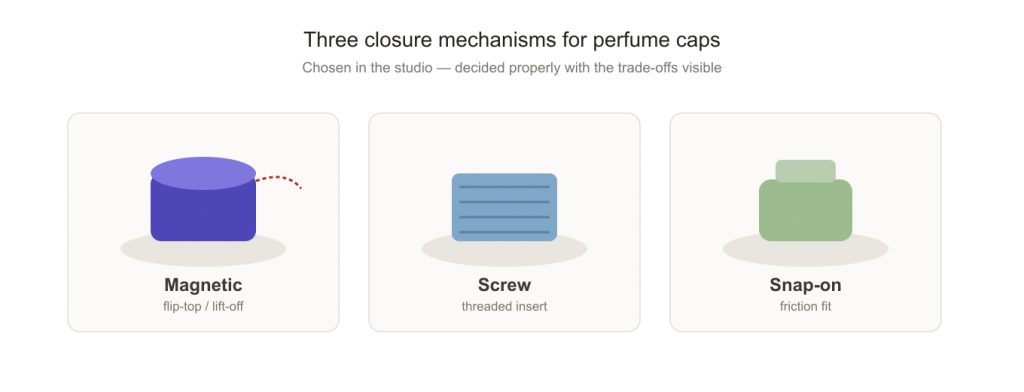
| Mechanism | How it closes | Bottle-side requirement | Feel | Typical use |
| Magnetic (flip-top or lift-off) | Magnet pair or magnet plus steel target | Smooth collar, pump flange or strike plate | Satisfying click, one-handed, “ritual” | Prestige fragrance, hero SKUs |
| Screw | Thread on the cap insert engages the bottle neck thread | Threaded neck (glass or collar) | Familiar, deliberate, two-step | Volume lines, refillable formats |
| Snap-on (press-on / FEA) | Friction fit over the pump flange or bottle mouth | Smooth pump flange of matching diameter | Quick, light, functional | Mass market, travel and value formats |
Two notes before the detail. First, “screw” splits into screw-thread caps (removable, refill-friendly) and crimp or crimpless FEA fittings (permanent, tamper-evident) — the distinction is covered in our guide on screw cap or sealed closures. Second, the mechanism choice constrains the bottle and pump choice, not the other way round: a magnetic cap on a screw-neck bottle needs a magnetic collar, and that collar is now part of your closure programme.
Magnetic: the ritual closer
What it does well. One-handed operation, a closing sound and feel that read as premium, sculptural freedom — flip-tops can take almost any outline the brand wants — and the deepest decoration palette, from deep engraving to Pantone-matched plating. It is the only mechanism that makes the act of opening part of the brand story, which is why prestige fragrance keeps returning to it.
What it costs you. The highest unit cost of the three: a magnet, a moulded insert, and an assembly step that the other two do not need. The bottle or pump needs a compatible target. Leak-proofing depends on the lining and its adhesion, and the hinge is a flexing interface that plating stacks must survive — the failure modes are covered in our guide on how magnetic zamak perfume caps work. And closing force is a specification you must set and test, not a property you receive.
Best for: hero SKUs, gift and limited editions, and any programme where the cap is the brand’s centrepiece and the volume justifies the tooling.
Screw: the workhorse
What it does well. The most reliable seal per unit cost, the simplest tooling, and full refill compatibility — a threaded neck accepts a refill bottle or a replacement pump without re-tooling the cap. Threaded inserts are standard, supply is deep, and every factory that moulds plastic can make one. Tamper-evident variants (crimp, crimpless FEA in 13, 15, 18 and 20 mm) add security for retail.
What it costs you. The opening is a two-step action — unscrew, lift — which is slower and less theatrical than a click. Threads constrain the cap outline: fine relief and deep undercuts fight the moulding, so the sculptural freedom of a flip-top is not available at the same price. Visible threads can also read “functional” rather than “premium” unless the finishing hides them.
Best for: volume lines, refillable and sustainability-led formats, and programmes where seal reliability and supply depth outrank theatre.
Snap-on: the functional option
What it does well. The cheapest mechanism of the three — a friction-fit cap over a standard pump flange, no magnet, no thread, minimal assembly. It fits the mass-market and travel formats where the closure is a cost line, not a brand asset, and it pairs with the widest range of stock pumps.
What it costs you. The least premium feel: light, quick, and easy to knock loose in a bag. One-handed use depends entirely on friction tuning against the pump flange, and the fit tolerance between cap and pump becomes the seal — which means two suppliers’ tolerances now stack. Decoration is possible but the light cap weight undermines the “substantial” perception that zamak buyers usually want.
Best for: value and mass formats, travel sizes, and test markets where the cap budget must stay near zero.
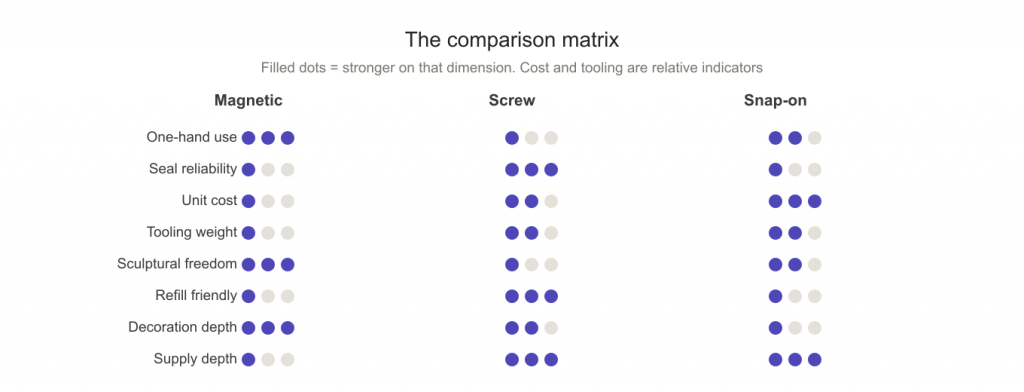
The comparison matrix
| Dimension | Magnetic | Screw | Snap-on |
| One-hand use | Excellent | Two-step | Good if friction is tuned |
| Seal reliability | Lining-dependent | Best in class | Tolerance-stacked |
| Unit cost (relative) | Highest | Middle | Lowest |
| Tooling | Shell plus insert plus assembly | Insert only | Insert only |
| Sculptural freedom | Highest | Thread-constrained | Middle |
| Refill friendly | No | Yes | Rarely |
| Decoration depth | Deepest | Deep | Standard |
| Supply depth | Specialist | Universal | Universal |
Cost and tooling entries are relative indicators — actual figures are quoted per design, quantity and finish, the same caution our comparison of zamac perfume caps applies to material-level numbers. On our programmes tooling is charged once, reorders and spare moulds are not re-billed, and sampling is quoted as its own line item regardless of mechanism.
How to choose: decision rules by brand situation
| Your situation | Lean toward | Why |
| Launch hero SKU, volume under 50k per design | Magnetic | The click carries the brand; tooling amortises over a small, high-margin run |
| Refillable or sustainability-led line | Screw | Refill compatibility is the story; threads are the cheapest way to keep it |
| Mass market or travel format | Snap-on | Closure is a cost line; stock pumps keep the programme simple |
| Sculptural, multi-piece cap | Magnetic | Threads and snap fits both constrain outline; hinge assemblies do not |
| Two-hand ritual acceptable, seal critical | Screw | Best seal per unit cost, deepest supply base |
| Magnetic cap on existing screw-neck bottle | Magnetic plus collar | Add a magnetic collar before bottle re-tooling; price the collar into the programme |
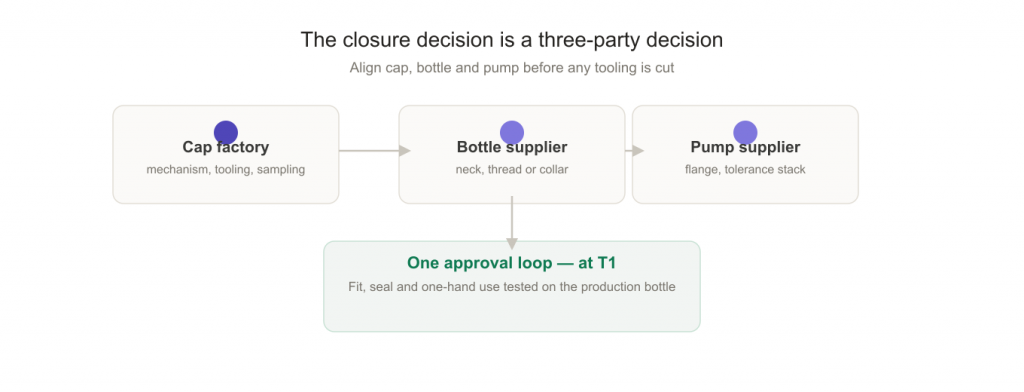
One process note applies to every row: whichever mechanism you choose, the bottle and pump enter the approval loop at T1, not after tooling. Fit, seal and one-hand operation are tested on your production bottle — the same principle our zamac cap sampling and T1 approval guide applies to first-article inspection.
What this means for your bottle and pump
The mechanism decision is really a three-party decision — cap factory, bottle supplier, pump supplier — and the cheapest moment to align all three is before any tooling is cut. Three questions settle most programmes:
- Does the bottle neck have a thread, a smooth collar, or a standard pump flange today?
- Who owns the tolerance stack between cap and pump — and who re-qualifies when one of them changes supplier?
- Is the closure a brand asset (magnetic), a reliability asset (screw), or a cost line (snap-on) in this programme’s budget?
If the answers point at magnetic, the format is proven in production: our zamac magnetic perfume cap runs the flip-top construction with built-in mirror on ZAMAC 3# alloy, and small-batch trial orders are supported ahead of a volume commitment. Whatever the mechanism, the factory checks are the same ones in our guide on how to vet a zamac cap manufacturer before you send an RFQ.

FAQ
Which closure is cheapest overall?
Snap-on on unit cost, screw on total programme cost once tooling is amortised. Magnetic carries the highest unit and tooling cost but buys the one-hand ritual — compare programmes, not price lists.
Can a magnetic cap be made refillable?
Not in the usual sense — a lift-off or flip-top cap is removed for refilling, but the refill itself needs a pump or bottle the cap still fits. If refill is central to the brand story, screw is the natural mechanism.
Do magnetic caps leak more than screw caps?
A correctly specified magnetic cap does not — the lining and its adhesion are the seal, and they are tested at T1. An under-specified one can. Screw caps are more forgiving because the thread compresses the seal mechanically.
Is a screw cap always less premium?
No. A screw cap with deep engraving, a heavy zamak shell and a matched plating finish reads premium; what it cannot do is the one-handed click. Premium is a finishing and weight question as much as a mechanism question — see why zinc alloy for perfume bottle caps.
Can we switch mechanisms after tooling?
Only by re-tooling. The mechanism is frozen in the insert and shell tooling, and the bottle interface may change too. Decide before the first cut — and put the closing-force or seal target in the drawing so sampling has something to measure against.
Which mechanism suits a small first order?
All three are quoted per design; on our programmes small-batch trial orders are supported for magnetic formats, and screw and snap-on tooling is the lightest of the three.
Next step
Send the bottle, the pump or sprayer, and the destination market. Our engineers return DFM feedback and a quotation before tooling is cut, sampling is quoted as its own line item and credited against your first production order. Browse the zamac perfume cap collection for finishes already in production, or read more about how we work as a custom zamac bottle caps manufacturer.
GuanChengXin (GCX) — zinc alloy die casting manufacturer in Dongguan, China. In-house tooling, die casting, CNC, polishing, plating and assembly for fragrance, spirits and home fragrance closures.