The magnetic cap has become the default “premium” closure in prestige fragrance: lift the cap and it clicks shut with a finality no screw thread quite delivers. It is also the format where buyers most often approve a beautiful sample and discover the failure mode six months later, in the field. This guide takes the mechanism apart — the shell, the insert, the magnet, the lining — and lists the checks that separate a magnetic cap programme you can scale from one that comes back as warranty claims. If you are still building the supplier list, start with how to vet a zamac cap manufacturer before you send an RFQ; everything below assumes the factory has already passed those checks.
The anatomy of a magnetic cap
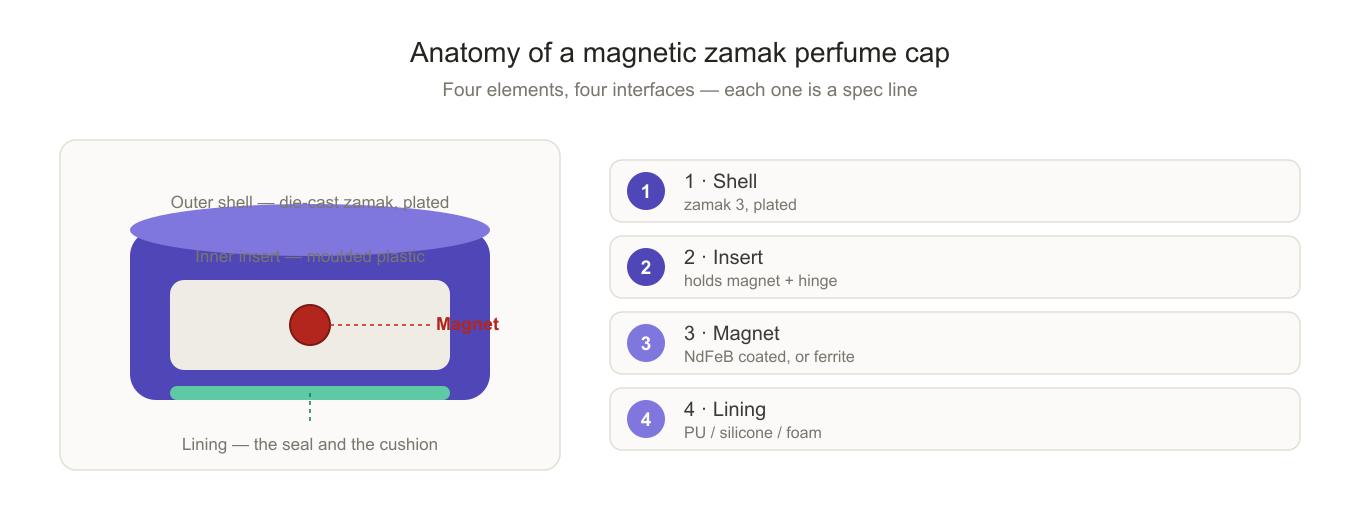
A magnetic zamak cap is not one part — it is an assembly, and every interface in that assembly is a potential failure point. A typical flip-top magnetic cap contains four elements:
| Element | What it does | Common choices |
| Outer shell | Carries the brand: weight, finish, engraving | Zamak 3 (zinc alloy), plated gold, rose gold, silver, black bronze |
| Inner insert | Holds the magnet and the hinge geometry, seats on the bottle neck | Injection-moulded plastic (POM / ABS / PP) |
| Magnet | Creates the closing force | NdFeB (neodymium) rare-earth, or ferrite |
| Lining | Seals against the pump or bottle mouth, absorbs the closing impact | PU, silicone, or foam-backed materials |
The shell is die-cast zamak — on our own magnetic programme, eco-friendly ZAMAC 3# alloy with water plating in real gold or a custom colour. The insert is moulded plastic. The magnet is a small rare-earth disc or ring pressed or glued into the insert, sometimes paired with a steel strike plate on the bottle side. The lining is the part most buyers never think about — and the part that most often decides whether the cap still feels premium after two hundred openings.
How the closure actually closes
Two magnet geometries dominate. In a flip-top (hinged) cap, the magnet pair sits across the hinge line so the cap swings shut and self-aligns; closing force comes from magnet attraction plus the hinge return. In a lift-off cap, a single magnet ring in the cap attracts a steel target on the collar or pump, and the cap simply pulls on and off. Flip-tops read more “ritual” and hide the magnet inside the cap body; lift-offs are simpler, cheaper to tool and easier to make leak-proof — but they need a compatible target on the bottle side, which makes the bottle or pump supplier part of your closure programme, not a separate purchase.
The number that describes the feel is closing force, expressed in newtons: too low and the cap feels loose and can open in a handbag; too high and it fights the user, especially one-handed. Ask your supplier to state the target closing-force range on the drawing and confirm it at sampling rather than after tooling — it is a design parameter, not a lucky outcome. Our magnetic caps are tested for fit, magnetic strength and leak-proof performance on every programme, but the target itself should come from your brand’s ergonomics decision.
Materials that decide the experience
Zamak 3 alloy. The standard zinc alloy for caps — roughly 96% zinc with about 4% aluminium and trace magnesium — casts fine detail, takes plating well, and has the substantial weight shoppers read as premium. Specify the low-lead, eco-friendly grade in writing at RFQ stage; retrofitting after tooling means requalifying the part.
The magnet. NdFeB rare-earth magnets give the strongest closing force in the smallest volume, but bare neodymium corrodes quickly — especially against perfume alcohol residues and hand creams. A production-grade magnetic cap uses plated (typically nickel-copper-nickel) and epoxy-coated magnets, fully encapsulated in the insert so the magnet never touches the product or the user. Ferrite magnets resist corrosion better but need more volume for the same force. Ask which grade, which coating, and how the magnet is retained — pressed, glued or overmoulded — because the retention method is what fails first.
The lining. PU liners give a soft, quiet close and a good seal; silicone liners survive higher temperatures and more aggressive formulations; foam liners are cheapest. Whichever you choose, adhesion to the insert matters more than the material itself — a lining that debonds turns a luxury cap into a rattle.
The plating stack. Gold, rose gold, silver, black bronze, brushed, sandblasted, anti-fingerprint — all available, all interacting with the hinge. A flip-top flexes at the hinge line on every opening, so a plating stack that is beautiful on a static sample can craze at the hinge within months. Ask for a cyclic-opening or hinge-abrasion test on plated assemblies, not just an adhesion cross-hatch on a flat coupon.
The checks that matter before you order
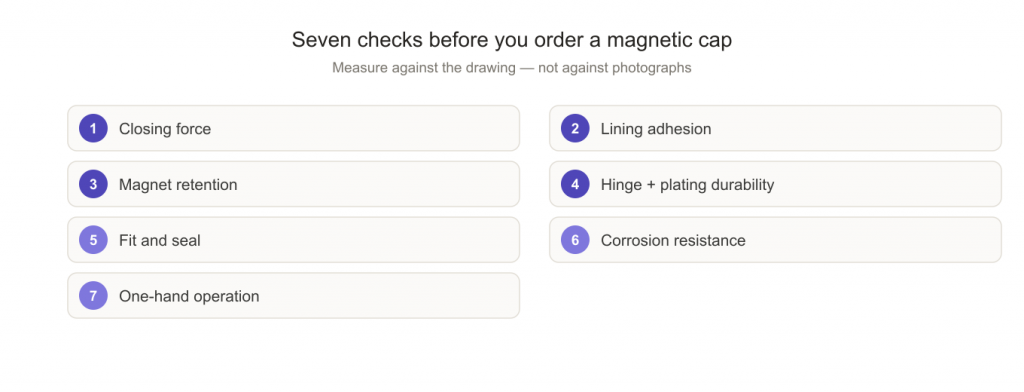
| Check | What “good” looks like | Typical failure it catches |
| Closing force | Measured within the stated range, cap to cap | Loose caps; caps that pop open in a bag |
| Lining adhesion | Peel or tensile test per lot, not per first sample | Lining falls out after weeks on shelf |
| Magnet retention | Destructive test on sample; magnet fully encapsulated | Magnet drifts; closing force varies |
| Hinge and plating durability | Cyclic opening test on plated parts | Plating craze at the hinge line |
| Fit and seal | Fit test on your actual bottle and pump | Gaps, leaks, misaligned click |
| Corrosion resistance | Salt-spray or equivalent on the plated assembly | Clouding and white rust under plating |
| One-hand operation | User test with your production bottle | Cap that needs two hands or slides off |
Two rules make the table work. First, measure against the drawing, not against photographs — “the sample looks right” is not an approval criterion, a point our zamac cap sampling and T1 approval guide makes at length. Second, test the production formulation: a lining or magnet change to a second supplier invalidates earlier test results.
Where magnetic caps fail
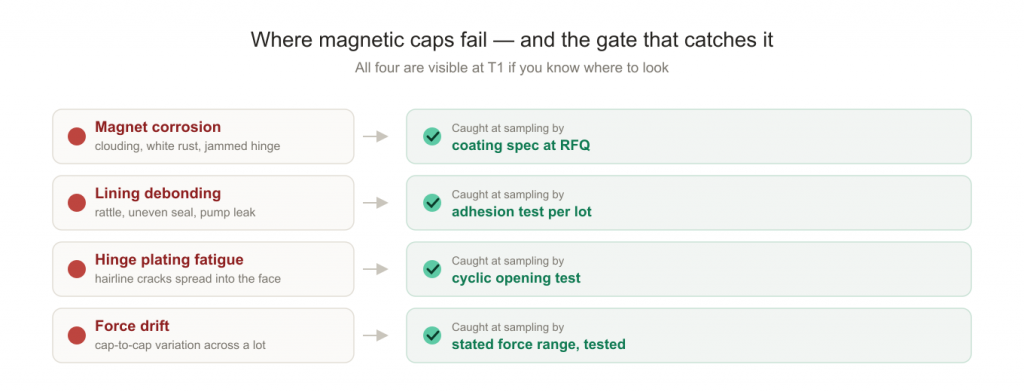
Field failures cluster in four places, and all four are visible at sampling if you know where to look:
- Magnet corrosion — clouding under the plating, then white rust products that jam the hinge. Caused by bare or under-coated NdFeB in a humid, alcohol-rich environment.
- Lining debonding — the cap opens fine but rattles, or the seal compresses unevenly and the pump leaks. Caused by adhesive or liner-supplier changes.
- Hinge plating fatigue — hairline cracks at the hinge line that spread into the visible face. Caused by a plating stack optimised for flat coupons rather than flexing assemblies.
- Force drift — closing force varies cap to cap across a production lot. Caused by magnet-grade or insert-tolerance variation; it shows up as a percentage of caps outside the stated range, which is why the range — not a single “good” sample — is the specification.
None of these are exotic, and all of them are cheaper to catch at T1 than at the retailer’s returns desk.
What the sampling stage must prove
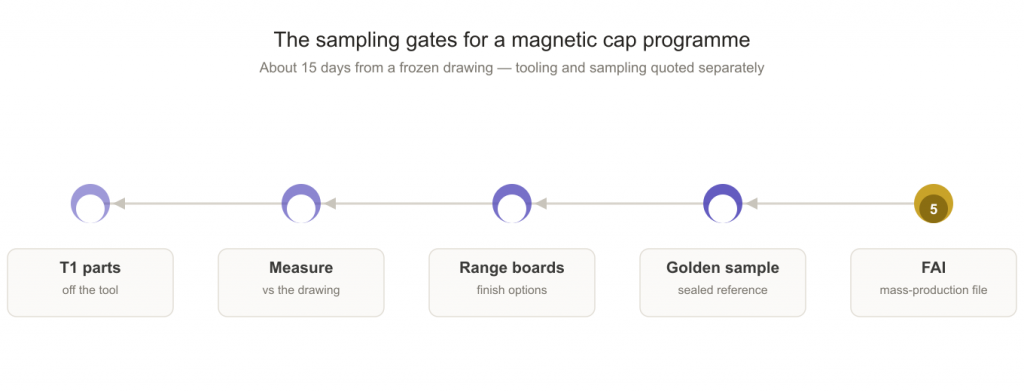
Sampling is where a magnetic cap programme is won or lost. The sequence is the one every closure programme should follow: T1 parts off the tool, dimensional and functional measurement against the drawing, range boards for finish, a sealed golden sample, then FAI documentation for mass production. On our programmes the sampling window runs about 15 days from a frozen drawing, tooling and sampling are quoted as separate line items, and the sampling fee is credited against your first production order.
What the magnetic-specific gates add: closing-force measurement on T1 parts (not just dimensions), lining adhesion on the production liner (not a lab liner), and a cyclic opening test on plated assemblies. Ask for the FAI report on the assembly — not only on the zamak shell — because the assembly is what ships.
Branding and decoration options
The magnetic cap is a branding surface, and the process list is long: deep engraving, emboss, deboss and laser etching on the top, sides or inner surface; Pantone-matched plating; gradient, pearl and metallic effects; brushed, sandblasted or anti-fingerprint finishes. Some programmes put a mirror inside the cap — a small practical luxury that adds an assembly step and one more interface to control. If you are comparing decoration routes, our guide on what can be engraved on a perfume bottle cap covers what each method can and cannot do at production depth. And if the team is still debating the format itself, common misconceptions about magnetic perfume caps and the materials and technologies behind magnetic bottle caps are worth ten minutes before the design freeze.
What drives the cost
Three line items move the unit price of a magnetic cap more than anything else: the magnet grade and coating, the lining (material plus adhesion process), and the depth of the plating stack. Tooling is charged once — reorders and spare moulds are not re-billed on our programmes — so the second and third orders of a proven design carry no mould cost. Small-batch trial orders are supported ahead of a volume commitment, which is the cheapest way to de-risk a new closure format before the launch is locked.
For the wider material question — how zamak compares with brass, aluminium, plastic and wood on weight, tooling and unit cost — our comparison of zamac perfume caps is the hub page. And if you want to see the format in production, our zamac magnetic perfume cap shows the flip-top construction with built-in mirror, in gold plating on ZAMAC 3# alloy.
FAQ
Are magnetic caps only for luxury perfume?
No — the mechanism suits any small closure where one-handed use and a secure click matter: fragrance, cosmetics, premium spirits and home fragrance. The luxury association comes from the weight and finish zamak allows, not from the magnet itself.
How long does a magnetic cap last?
That is a specification question, not a format question. A correctly specified cap — coated NdFeB or ferrite, fully encapsulated, adhesion-tested liner, hinge-rated plating — is designed for the product’s life; an under-specified one fails in months. Put the cyclic-opening expectation in the brief and test it at T1.
Can the closing force be adjusted after tooling?
Within limits. Magnet grade and geometry are the main levers, and both live in the insert tooling. Treat closing force as frozen at drawing stage; changing it later means insert changes and re-sampling.
Do magnetic caps work with screw-neck bottles?
Not directly — a magnetic cap needs a smooth target such as a collar, pump flange or strike plate. If your bottle is screw-neck, either specify a magnetic collar or compare closure mechanisms before the bottle tooling is cut; our guide on screw cap or sealed closures is the starting point for that comparison.
Is the magnet safe near the product?
In a properly built cap the magnet is fully encapsulated in the plastic insert and never contacts the formulation. Ask for the construction detail — encapsulated, overmoulded or glued — and the material declarations for both insert and lining.
What documents should I request with a magnetic cap order?
The same pack as any zamak closure: alloy certification, plating chemistry documentation, an FAI report on the assembly, lining adhesion results, and a COC per shipment. The full list is in our guide to closure compliance for wine and spirits.
Next step
Send the bottle, the pump or sprayer, and the destination market. Our engineers return DFM feedback and a quotation before tooling is cut, sampling is quoted as its own line item and credited against your first production order. Browse the zamac perfume cap collection for finishes already in production, or read more about how we work as a custom zamac bottle caps manufacturer.
GuanChengXin (GCX) — zinc alloy die casting manufacturer in Dongguan, China. In-house tooling, die casting, CNC, polishing, plating and assembly for fragrance, spirits and home fragrance closures.