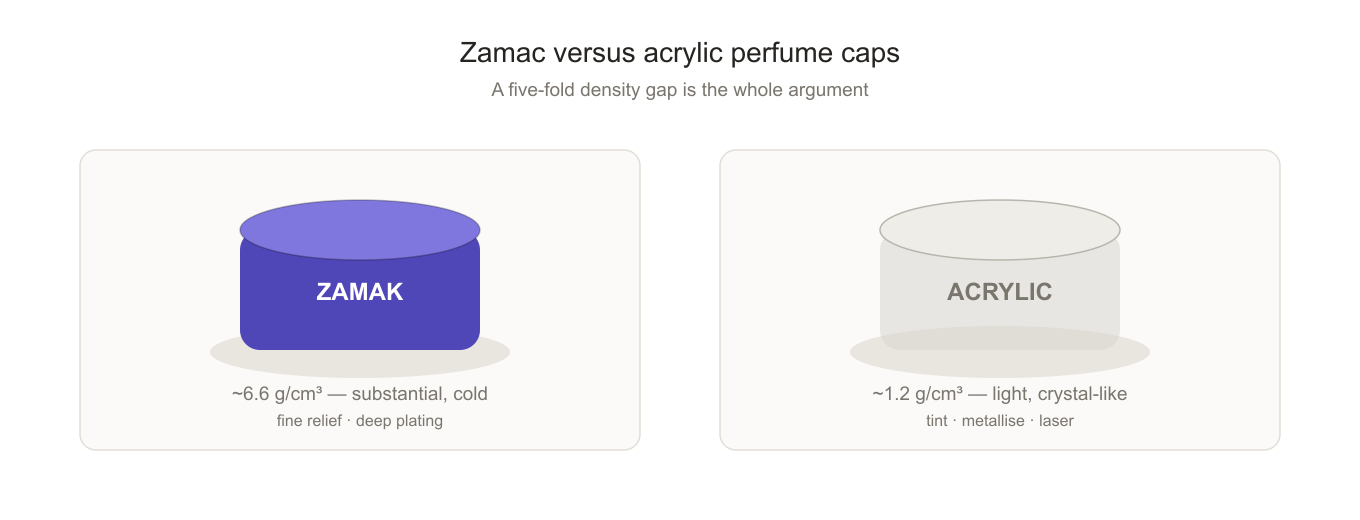
Every brand that specifies a metal cap eventually asks the acrylic question — usually in the meeting where the design loves the weight and depth of zamak and the budget whispers about alternatives. Acrylic and resin caps are a genuine route in premium packaging: they can be tinted, metallised, engraved and moulded into crystal-like shapes at a fraction of the weight. This guide compares zamak against acrylic and resin on the dimensions that decide programmes — weight and feel, tooling, unit cost, finishing, durability and product compatibility — so the material argument is settled with numbers rather than impressions. For the full five-material picture, our comparison of zamac perfume caps remains the hub.
What “acrylic” means in packaging
Two materials travel under the same loose label, and they behave differently:
- PMMA (acrylic) — the cast or injection-moulded “crystal” plastic: transparent or tintable, hard, glossy, about 1.2 g/cm³. It is what most people mean by an acrylic cap.
- Polyester resin — cast or compression-moulded decorative material: heavier than PMMA, often stone- or pearl-like, metallised or painted. It reads more “object” than “closure”.
Both can be plated or metallised, both can carry engraving, and both are injection- or cast-moulded rather than die-cast — which is the structural difference from zamak. Zamak (zinc alloy) is cast under pressure in steel dies, then polished and electroplated; its identity is weight plus metal finish.
The head-to-head matrix
| Dimension | Zamak (zinc alloy) | Acrylic (PMMA) | Polyester resin |
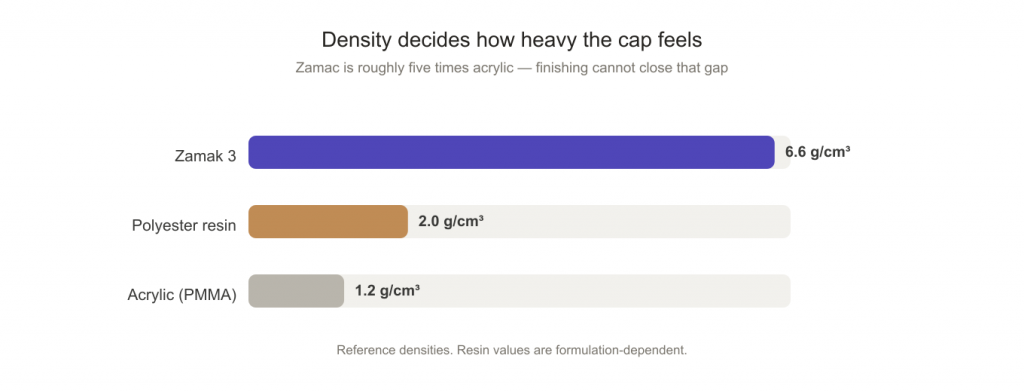
| Density | ~6.6 g/cm³ | ~1.2 g/cm³ | ~1.8–2.1 g/cm³ (formulation-dependent) |
| Weight feel | Substantial, “cold” metal | Light, crystal-like | Moderate, stone-like |
| Tooling | Hot-chamber die-cast steel dies | Injection steel tools | Cast or compression tools |
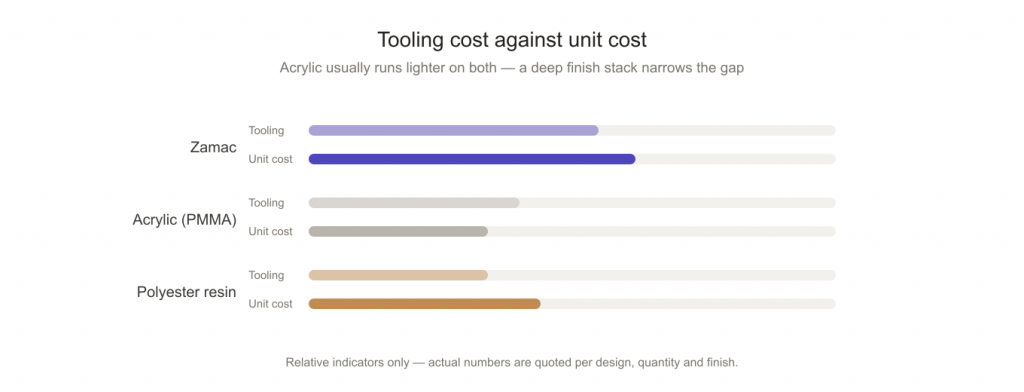
| Unit cost at volume | Middle to high | Typically lowest | Low to middle |
| Detail and relief | Fine cast relief, sharp edges | Good, softer edges | Good for organic shapes |
| Finishing | Electroplate: gold, rose gold, silver, bronze; brushed; sandblast | Paint, vacuum metallising, UV, tint, laser | Paint, metallising, inlays |
| Durability | Dents, not cracks; plating can chip at edges | Hard but brittle; scratches visibly; can craze with some solvents | Can chip on impact; finishes vary |
| Product compatibility | Established with alcohol contact | Confirm per formulation | Confirm per formulation |
| Recyclability | Alloy scrap retains value | PMMA stream if unmmetallised | Limited if metallised |
Density, cost and durability rows are reference values and relative indicators — actual figures are quoted per design, quantity and finish, the same caution our material hub applies to its own numbers.
Weight and feel: the honest difference
This is the axis zamak wins outright, and it is not a small win. A zamak cap at ~6.6 g/cm³ weighs roughly five to six times an identical PMMA cap — the “substantial” perception shoppers read as premium is mostly density. Acrylic counters with optics rather than mass: transparency, tint depth and a crystal-like glow that metal cannot produce, which is why acrylic and resin often win in decorative and seasonal formats where the cap is a colour object rather than a metal one.
If your brand’s premium cue is weight and click, no finishing route closes a 5× density gap. If the premium cue is light, colour and translucency, zamak cannot follow. The decision is brand positioning, not engineering.
Tooling and unit cost
Zamac caps are cast in hot-chamber steel dies; acrylic caps are injection-moulded. Both are steel-tool investments, and at similar complexity acrylic tools are usually the lighter commitment — but the gap is programme-specific, so treat tooling comparisons as relative until quoted. The unit-cost picture is more stable: acrylic resin is cheaper per kilogram than zinc alloy and the part is far lighter, so at volume acrylic typically runs below zamak on unit price. The counterweight is finishing: a full plating stack on zamak and a metallising or UV stack on acrylic both add process cost, and the deeper the decoration, the closer the two converge.
On our zamak programmes, tooling is charged once — reorders and spare moulds are not re-billed — and sampling is quoted as its own line item and credited against the first production order. Whichever material you choose, ask for tooling, sampling and unit price as three separate numbers; a single blended figure hides the real trade-off.
Finishing and decoration
Zamac’s decoration identity is electroplating: gold, rose gold, silver and black bronze in glossy, brushed, sandblasted or anti-fingerprint variants, with engraving, emboss and laser etching on top — the palette behind our surface treatment techniques for unique branding overview. Acrylic decorates differently: tinting through the body, vacuum metallising, painting, UV coating and laser marking — processes that put colour inside the material rather than on its surface.
Two practical consequences. Engraving reads differently: on zamak it cuts into plated metal and can reveal layers; on acrylic it frosts or scores a translucent surface. And depth of relief is a casting question — zamak die-casting holds fine, sharp detail that injection acrylic approximates but does not always match at the same edge definition. If the design leans on fine relief, ask for both routes sampled before the material is fixed; our guide on what can be engraved on a perfume bottle cap covers what each process can do at production depth.
Durability and product compatibility
Field behaviour differs in kind, not just degree. Zamak dents rather than cracks, and its weakness is the plating edge — a chip at the hinge or rim exposes the alloy, which can then dull or white-rust. Acrylic is hard but brittle: it scratches visibly under abrasion and can craze or crack under impact or under some solvent-heavy formulations, so compatibility with the specific fragrance formula should be confirmed before the format is locked. Resin sits between the two but is formulation-sensitive in the same way.
The compatibility question is the one buyers most often skip. Perfume is largely alcohol with a fragrance load; a cap that is fine with one formulation can craze with another. Whichever material wins the design argument, ask for the compatibility position in writing before tooling.
Where each material wins
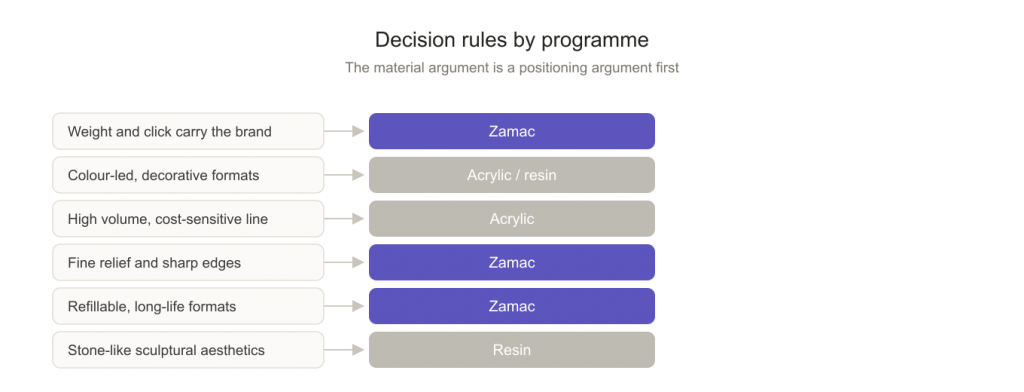
| Your programme | Lean toward | Why |
| Prestige fragrance where weight and click carry the brand | Zamak | Density and plating depth are the premium cue |
| Decorative, seasonal or colour-led formats | Acrylic or resin | Tint, translucency and glow metal cannot produce |
| High volume, cost-sensitive line | Acrylic | Lighter resin and simpler finishing lower unit cost |
| Fine relief and sharp edges in the design | Zamak | Die-cast edge definition |
| Refillable or long-life formats | Zamak | Metal durability with documented plating stack |
| Heavy sculptural or stone-like aesthetics | Resin | Cast organic shapes at moderate weight |
One more layer sits on top of the material choice: the closure mechanism. Magnetic, screw and snap-on behave differently on the same material, and a magnetic flip-top on zamak is a different programme again — see how magnetic zamak perfume caps work for the mechanism detail, and the magnetic vs screw vs snap-on comparison for the mechanism trade-offs. If the decision is really “metal or not metal”, our guide on why zinc alloy for perfume bottle caps and the five-material hub are the fastest way to frame it.
FAQ
Is acrylic cheaper than zamak?
On unit price at volume, typically yes — the resin is cheaper per kilogram and the part is far lighter. Tooling and finishing can narrow the gap, and a deep decoration stack on either material moves the number. Compare quoted programmes, not material prices.
Does an acrylic cap feel cheap?
It feels light, which reads cheap only if the brand cue is weight. In decorative and colour-led formats acrylic reads as crystal, not plastic. The feel question is a positioning question — decide the cue first.
Can acrylic be plated like zamak?
It can be metallised by vacuum deposition or painted with metallic finishes, but the result is a coating on plastic rather than electroplate on metal — different edge behaviour, different scratch profile, and worth sampling before commitment.
Which material is more durable in the field?
Different failure modes. Zamak dents and can chip at plating edges; acrylic scratches visibly and can craze with impact or solvent-heavy formulations. For long-life and refillable formats, zamak’s documented durability usually wins.
Is zamak recyclable?
Yes — zinc alloy scrap retains value and re-enters the alloy stream, which is one reason eco-friendly low-lead grades are specified at RFQ stage. Acrylic is recyclable in PMMA streams while unmmetallised; metallised or painted finishes complicate that.
Can you quote both materials for the same design?
On our programmes the zamak route is quoted end to end — tooling, sampling, plating and assembly — and we are glad to review designs destined for acrylic or resin with DFM feedback before you commit elsewhere. Send the drawing package either way.
Next step
Send the drawing package, the bottle or pump, and the destination market. Our engineers return DFM feedback and a quotation before tooling is cut, sampling is quoted as its own line item and credited against your first production order. Browse the zamac perfume cap collection for finishes already in production, or read more about how we work as a custom zamac bottle caps manufacturer.
GuanChengXin (GCX) — zinc alloy die casting manufacturer in Dongguan, China. In-house tooling, die casting, CNC, polishing, plating and assembly for fragrance, spirits and home fragrance closures.