Most RFQ delays are not price negotiations. They are drawing problems: a dimension that cannot be measured as drawn, a parting line the factory was not told about, a revision that reached the tool room a week after tooling started. The fix is boring and effective — send a complete drawing package the first time.
This guide is written for buyers preparing a custom closure package for quotation and sampling. It covers the minimum package, the tolerances that actually matter on a zamac cap, draft angle and parting line rules specific to zinc die casting, wall thickness logic, and the DFM feedback a competent factory returns before quoting. When you vet a zamac cap manufacturer before you send an RFQ, this package is also the test: how fast and how specifically they answer it tells you what the programme will feel like.
The minimum drawing package
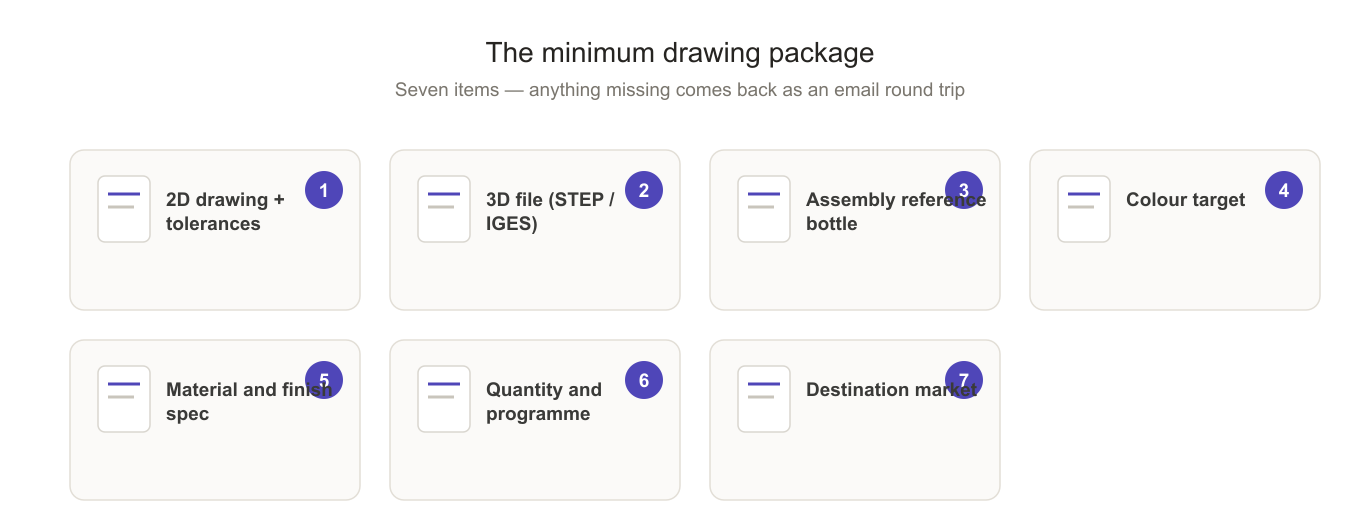
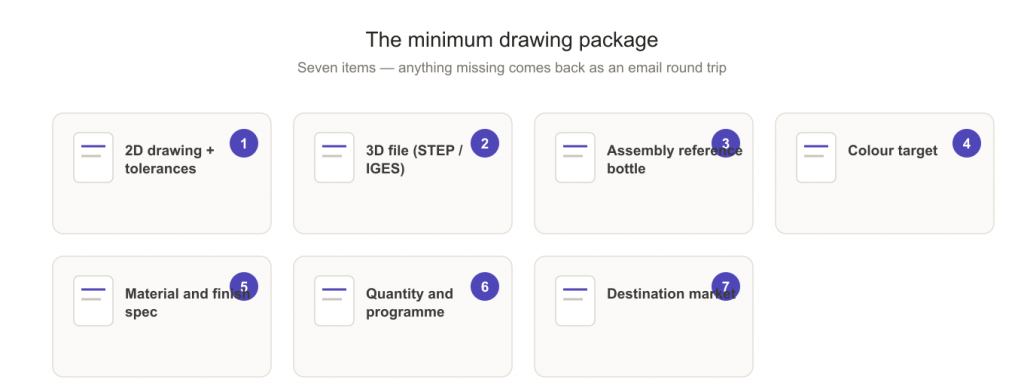
A complete package answers the factory’s questions before they have to ask. The table below is the minimum we work from; anything missing is a question that will come back by email, and each round trip costs days.
| Item | What good looks like | What happens without it |
| 2D drawing | Critical dimensions with tolerances; the 3–4 dimensions that decide assembly clearly marked | Factory guesses which dimensions matter; the guess surfaces at sampling |
| 3D file | STEP or IGES, single revision, matching the 2D | Interpretation drift between drawing and model |
| Assembly reference | Your production bottle or neck sample | Fit issues found only at T1 — the expensive place to find them |
| Colour target | Pantone reference, physical cap, or the approved range board | “Gold” means different things to different people |
| Material and finish spec | Alloy grade expectation and the plating stack you want | Substitutions quoted silently |
| Quantity and programme | Sample quantity now, expected annual volume | Tooling strategy quoted for the wrong lifetime |
| Destination market | EU, US or both | Compliance scope retrofitted later at higher cost |
If the material decision is still open, settle it before the package goes out: our comparison of how zamak compares with brass, aluminium, plastic and wood is the fastest way to a defensible choice — and remember that sampling the wrong material twice is the most expensive mistake at this stage, as our guide to the the T1 sampling gates explained shows.
Tolerances that matter on a zamac cap
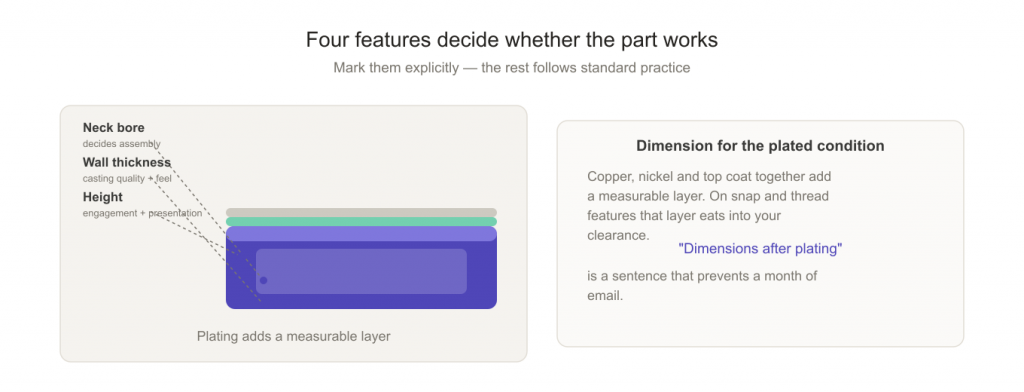
Not every dimension deserves a tolerance fight. On a closure, four features decide whether the part works, and they are the ones to mark explicitly on the drawing:
| Feature | Why it decides the part | What to specify |
| Neck bore / thread or snap profile | Decides assembly on your filling line | Tolerance per your bottle spec; state the mating component |
| Height / overall dimension | Decides presentation and, for screw caps, engagement length | Tolerance tied to function, not appearance |
| Wall thickness | Decides casting quality and feel | A nominal with a plus/minus band, not “as thin as possible” |
| Visible-surface zones | Decides where parting lines and tool marks are unacceptable | Mark the zones on the drawing, not in an email |
One zamak-specific note: plating adds thickness. Copper, nickel and top coat together add a measurable layer, and on snap or thread features that layer eats into your clearance. If your closure is a tight fit, ask for the drawing to be dimensioned for the plated condition and state it — “dimensions after plating” is a sentence that prevents a month of email.
Draft angle and parting line: what die casting needs
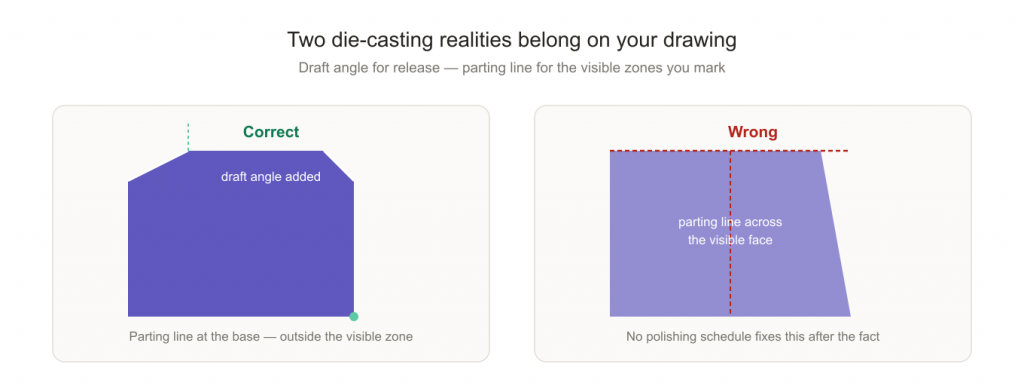
Two die-casting realities belong on your drawing even though they are the factory’s problem to solve.
Draft angle. Zinc alloy dies against the tool wall, so vertical walls need a taper to release cleanly. On a closure this mostly matters on the inside of deep features — the inner wall of a tall cap, the bore of a deep socket. The factory will add draft where needed; your job is to say where draft is not acceptable, because that changes the tool strategy and sometimes the design.
Parting line. The parting line is where the two halves of the tool meet, and it leaves a fine witness line on the part. On a cap, that line usually runs along the side — exactly where it is visible when the bottle sits on a shelf. Specify the parting line position on the drawing and mark the visible zones. A parting line placed across a logo or on the front face of a display cap is a design failure that no polishing schedule can fix afterwards.
For the tooling side of this logic, our overview of die-casting mould design for zinc alloy caps goes deeper into how gate and vent placement interacts with these two features.
Wall thickness and zamak-specific design rules
Zinc alloy flows well, which is why it carries fine relief and crisp engraving — but it is still a casting process, and thickness discipline decides both quality and cost:
- Keep walls uniform where you can. Thick sections next to thin ones cool at different rates and become the porosity you meet later at plating.
- Avoid isolated heavy bosses. A solid lug on a thin-walled cap invites shrinkage; a ribbed or cored equivalent casts cleaner.
- Think in relief, not in solid metal. Embossed logos and textured surfaces read as premium and cast better than deep, solid pockets.
- Ask for the casting simulation. For anything beyond a simple cap, a factory running flow simulation before cutting steel is telling you something about how it handles risk.
None of this requires you to become a tooling engineer. It requires the drawing to leave the factory room to do its job — and to mark clearly where you will not accept compromise.
DFM feedback: what a good factory sends back before quoting
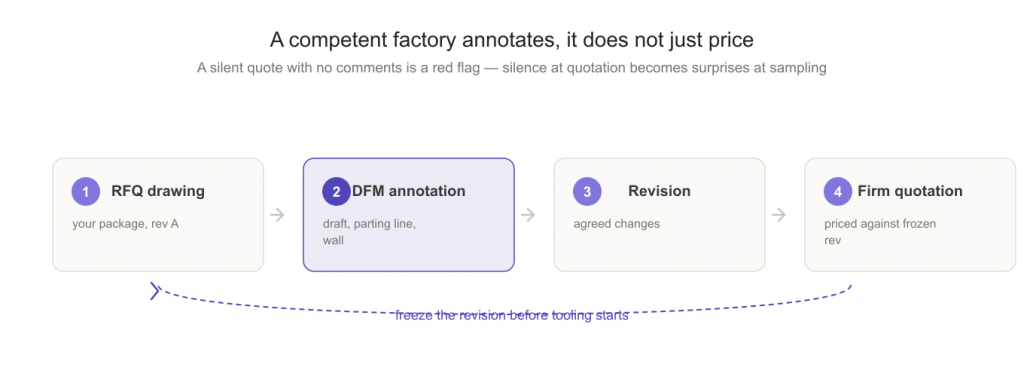
The single most informative moment in an RFQ is the engineering reply. A competent factory does not just price your drawing; it annotates it. Expect comments on:
- Draft and release — where the tool needs taper and what that does to your visible surfaces.
- Parting line position — proposed placement, flagged against your marked visible zones.
- Wall thickness transitions — the thick-to-thin junctions that will cast as porosity.
- Plating interaction — features that will lose clearance once the full stack is on, especially snap and thread.
- Assembly ergonomics — torque, retention, liner fit on your bottle.
- Quotation assumptions — the quantities, finishes and destinations the price actually assumes.
A silent quote with no comments is a red flag, and it is Check 9 on the vetting list for a reason: silence at quotation becomes surprises at sampling.
File formats, revisions and confidentiality
Practical housekeeping that prevents the classic disasters:
- Send both a 3D file and a 2D PDF. STEP or IGES for the model; PDF for the dimensioned drawing. A 3D file alone does not tell the factory which dimensions you consider critical.
- Version everything. Every file carries a revision letter and date, and the email that transmits it says so. “Final_v3_REALfinal” is how tools get cut to the wrong revision.
- Freeze before tooling. Tooling starts against a released revision. Changes after that point are tool modifications, with the time and cost that implies — the same pause mechanism described in our sampling timeline.
- NDA before artwork. If the cap carries unreleased branding, ask for a mutual NDA with the RFQ. It is a standard request and a reasonable factory signs without drama.
- Keep one thread. All revisions in one email thread or one project folder. Drawing control is boring right up until the day it saves the programme.
FAQ
Can you quote from a 3D file alone? We can give an indicative price, but a firm quotation needs the 2D drawing with critical dimensions and tolerances — the 3D file says what the part is, the drawing says what matters about it.
What tolerance should I ask for? Ask for the loosest tolerance that still works. Over-tight tolerances raise cost and scrap without improving the part; mark function-critical dimensions and leave the rest to standard practice.
Can I specify the parting line? Yes — mark it on the drawing and we will confirm feasibility in the DFM reply, including what it means for the visible surfaces.
Who owns the tooling and the drawings? Tooling you pay for is yours, including reorders and spare moulds without re-charge. Your drawings stay yours; we do not share customer designs.
What if my drawing has an error you catch? You get the DFM comment before tooling, with the proposed fix. Catching it at quotation is free; catching it at T1 is a tool modification.
Do you sign an NDA before seeing artwork? Yes — send it with the RFQ and we will return it signed before any artwork is shared with the tool room.
Next step
Send the package: 2D drawing with tolerances, 3D file, your bottle sample, colour target, quantity and destination market. Our engineers return DFM feedback and a quotation before tooling is cut, and the tooling itself is built in our own tool room. If you are still choosing between materials, start from how zamak compares with brass, aluminium, plastic and wood; if you are weighing regions as well as materials, browse the zamac wine bottle cap collection to see what is already in production.
Read more about how we work as a custom zamac bottle caps manufacturer, then send the RFQ.
GuanChengXin (GCX) — zinc alloy die casting manufacturer in Dongguan, China. In-house tooling, die casting, CNC, polishing, plating and assembly for fragrance, spirits and home fragrance closures.