Most brands meet child resistance the same way: late. A retail listing asks for it, a state compliance officer asks for it, or a tender document asks for it — after the factory has cut the bottle tooling and the closure sits in production. Because a CR requirement changes the closure system rather than decorating it, the late discovery usually means a new closure, a new test and a delayed launch. This guide sets out when the rules actually bite, how the test works, and what to put in the brief so the question gets answered at drawing stage.
What “child-resistant” actually means
A child-resistant (CR) closure is not simply a cap a child struggles with. The term points to a defined performance standard: the packaging must resist opening by young children while staying usable by older adults, and the test measures both halves of that promise with human panels rather than laboratory guesses.
Two documents carry most of the weight worldwide. In the United States, the Poison Prevention Packaging Act (PPPA) drives the rules through the CPSC regulations at 16 CFR Part 1700. Internationally, ISO 8317 sets the requirements and test methods for child-resistant reclosable packages, and the EU applies child-resistant fasteners to certain classified substances and mixtures under the CLP Regulation. Therefore, a programme that sells into both regions usually designs to the stricter of the two protocols from the start.
When US law requires a CR closure
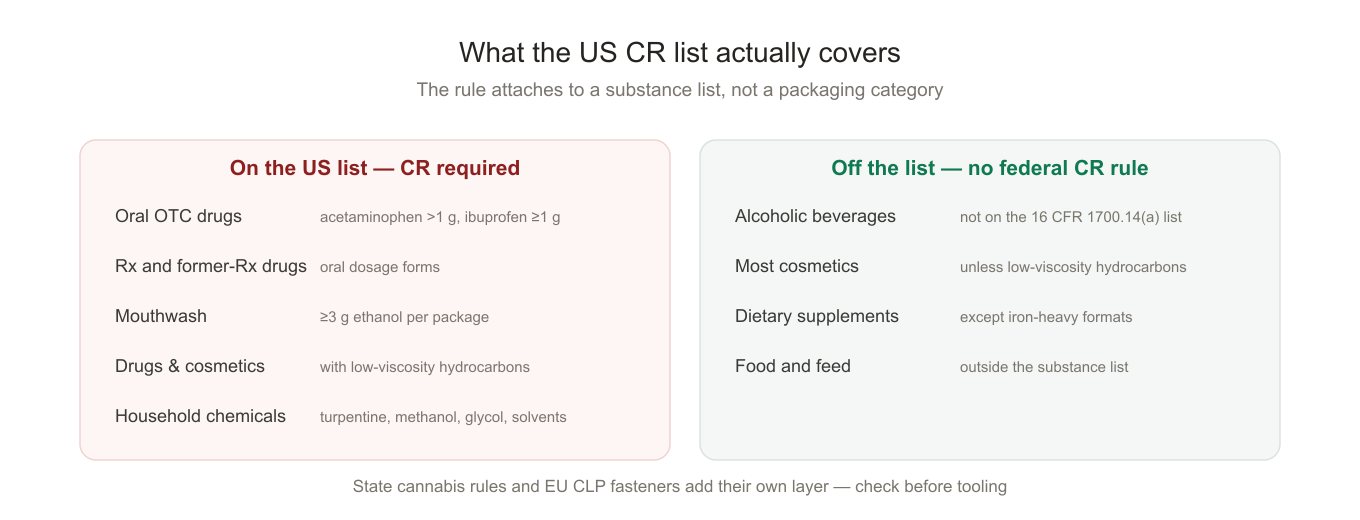
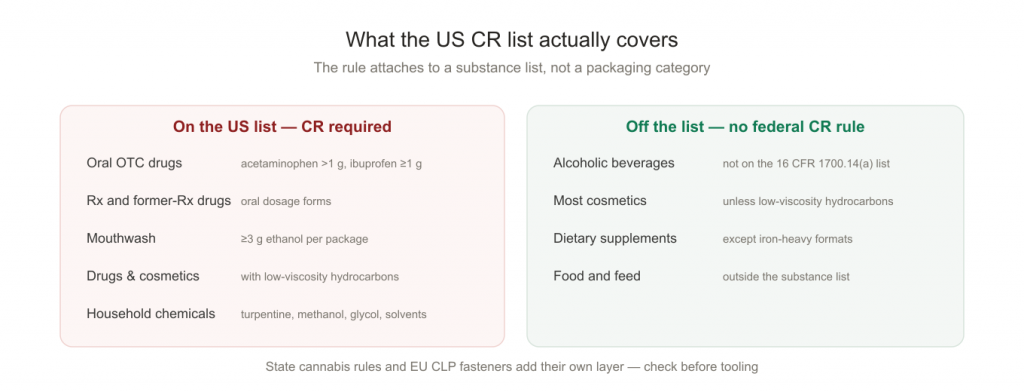
The US requirement attaches to a list of substances in 16 CFR 1700.14(a), not to a packaging category. If your product appears on the list, the retail package needs special packaging that meets the performance test; if it does not, no federal CR rule applies. The list runs to 33 paragraphs, and paragraph (14) stays reserved, so 32 substance categories carry the requirement. The ones buyers ask about most often sit in these groups:
| Product group on the list | Examples the regulation names | Note for buyers |
| Oral OTC drugs | Acetaminophen above 1 g per package; ibuprofen 1 g or more; diphenhydramine above 66 mg; naproxen; loperamide | Dose per package drives the requirement |
| Prescription and formerly prescription drugs | Oral dosage forms; OTC versions of former prescription actives | Exemptions exist for specific low-dose formats |
| Alcohol-containing mouthwash | Mouthwash with 3 g or more of ethanol per package | A narrow pump-dispenser exemption applies |
| Drugs and cosmetics with low-viscosity hydrocarbons | Products with 10%+ hydrocarbons and viscosity under 100 SUS | Spray-only formats and pads that cannot free-flow are exempt |
| Household chemicals | Turpentine, methanol, ethylene glycol, paint solvents, sodium/potassium hydroxide, methacrylic acid | Concentration and form decide |
Two entries deserve the exact wording, because buyers quote them loosely. The mouthwash paragraph covers preparations for human use that contain 3 g or more of ethanol in a single package, and it defines the term broadly — mouthwashes, mouthrinses, oral antiseptics, gargles, fluoride rinses, anti-plaque rinses and breath fresheners all count, while throat sprays and aerosol breath fresheners stay outside. The pump-dispenser exemption holds only when the dispenser is nonremovable, delivers at least 7% mint or cinnamon flavouring oils by weight, dispenses no more than 0.03 g of absolute ethanol per actuation, and holds less than 15 g of ethanol per unit. The hydrocarbons paragraph covers prepackaged non-emulsion liquid household products that qualify as drugs or cosmetics under the FDCA, contain 10% or more hydrocarbons by weight, and flow below 100 SUS at 100 °F, with exemptions for spray-only access and for products whose liquid cannot flow freely.
Now the part that surprises spirits brands: plain alcoholic beverages do not appear on the list, because the Act works from the substance list rather than a product category. A whiskey, gin or vodka bottle therefore does not need a federally mandated CR closure in the US. However, two practical exceptions shape the market. First, alcohol-adjacent products do appear on the list — mouthwash with 3 g or more of ethanol per package among them. Second, cannabis and THC beverages in legal states typically carry state-level child-resistance rules that go beyond the federal list, and those rules change state by state.
In the EU, the picture inverts: the CLP Regulation requires child-resistant fasteners on packaging for certain classified substances and mixtures, and ISO 8317 supplies the test protocol. Therefore, a chemical-adjacent product exported to Europe can face a CR requirement that the US list does not impose — check the classification before the factory cuts the closure tooling. For the wider compliance context on closures and liners, our closure compliance guide for wine and spirits covers REACH, RoHS, Prop 65 and migration testing.
When brands specify CR anyway
Plenty of programmes specify child-resistant closures where no federal rule forces the move, and the reasons cluster in four places. State rules lead: cannabis and hemp programmes face state-by-state requirements that usually reference the same 16 CFR 1700.20 or ISO 8317 protocols. Retail and insurance requirements follow, especially for ethanol-adjacent products sold through channels that impose their own packaging standards. Liability strategy matters too, because a documented CR programme answers the first question after any household incident. And some formats simply need the mechanics — metered pumps, droppers and dispensing closures that limit the dose per actuation behave like CR by design.
The commercial trade-off deserves honesty: CR mechanisms add cost, add line friction and can undercut a premium unboxing experience, because the same resistance that stops a child also stops a gift recipient. Specify CR where the regulation, the channel or the liability picture demands it, and treat “feels safer” as a marketing claim you must then substantiate.
How the CR test works
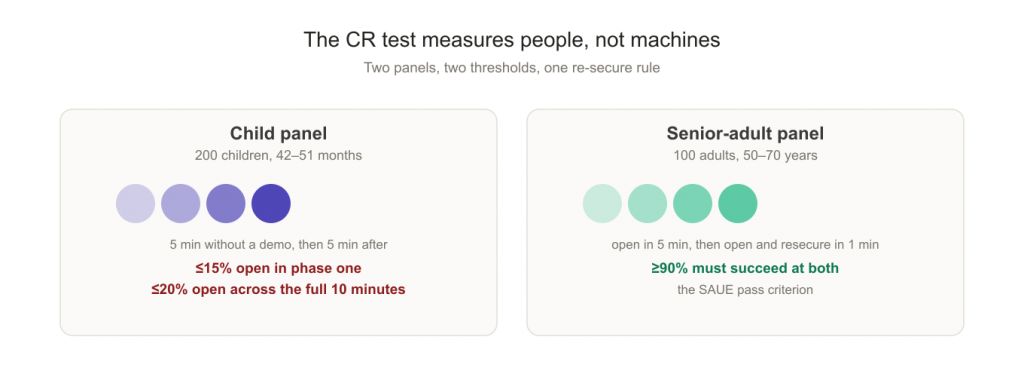
The protocol tests people, not machines, and the numbers matter because they set the design difficulty:
The child panel. The test panel draws 200 children aged 42–51 months. Each child gets five minutes to open the package without a demonstration; the tester then shows the opening method once and gives five more minutes. The package passes when no more than 15% of the children open it in the first phase and no more than 20% open it across the full ten minutes. The US regulation allows a sequential version of this protocol that starts at 50 children and extends up to 200.
The senior-adult panel. The protocol tests 100 adults aged 50–70 — 25% aged 50–54, 25% aged 55–59 and 50% aged 60–70, with 70% of the 50–59 and 60–70 groups female. Each participant opens one package within five minutes and then opens and properly resecures a second within one minute. The package passes when at least 90% succeed at both tasks — the senior adult use effectiveness, or SAUE.
The reclose rule. A CR package must re-secure, not just open. A closure that passes the opening test but fails to re-lock under the one-minute rule fails the protocol.
The per-design rule. The report covers one closure design. A change to the resin, the dimensions, the liner or the assembly can invalidate the test, so treat the tested configuration as frozen and re-test any change deliberately.
None of this happens quickly. Panels need recruiting and scheduling, and a failed panel means a design iteration rather than a paperwork fix. Therefore, brands that know CR applies usually book the test slot before they finish the closure design.
How a CR programme differs from a standard closure programme
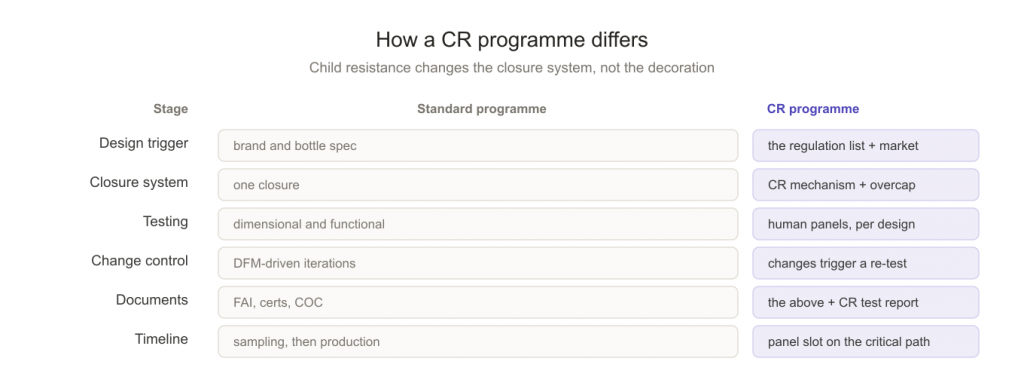
Child resistance changes the closure system, not the decoration. The table below is the difference buyers should plan around:
| Stage | Standard closure programme | CR closure programme |
| Design trigger | Brand and bottle spec | The regulation list plus the destination market |
| Closure system | One closure | A CR mechanism (usually plastic push-and-turn or squeeze-and-turn) plus any decorative overcap |
| Testing | Dimensional and functional checks at sampling | Human-panel testing to 16 CFR 1700.20 or ISO 8317, per design |
| Change control | DFM-driven iterations | Any change to the tested configuration triggers a re-test decision |
| Documentation | FAI, material certs, COC | The above plus the CR test report and the closure’s certification trail |
| Timeline | ~15 days sampling, then production gates | Panel scheduling on the critical path; build the test window into the launch plan |
Three mechanisms cover most of the market, and each behaves differently on the line and in the hand. Push-down-and-turn is the workhorse: press axially, then rotate, in polypropylene. Line-up-arrows asks the user to align moulded arrows and then twist, which reads intuitive for seniors and prints cleanly. Squeeze-and-turn works the flanks while turning, and it suits round or oval packs where a press action reads awkwardly.
One more distinction helps when reading supplier claims: a CR closure and a tamper-evident band solve different problems. Tamper evidence shows interference; child resistance measures a panel’s ability to open the package. Many regulated products need both, and the two features sit in different parts of the closure system.
What to ask your closure supplier
Whichever supplier you shortlist, the same checklist separates a CR-capable programme from a hopeful one:
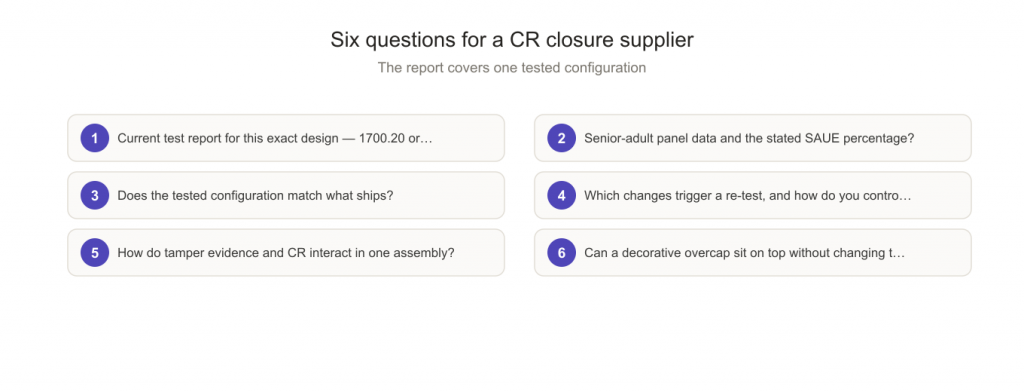
- Do you hold a current test report for this exact closure design, and which protocol does it follow — 16 CFR 1700.20 or ISO 8317?
- Does the report include the senior-adult panel data, and does it state the SAUE percentage?
- Does the tested configuration match the closure you would ship us — resin, liner, dimensions and assembly?
- How do you control changes, and which changes trigger a re-test?
- If the product also needs tamper evidence, how do the two features interact in one assembly?
- Can a decorative overcap sit on the CR mechanism without changing the test result?
The supplier-selection discipline behind these questions is the same as for any closure programme: our guide on how to vet a zamac cap manufacturer before you send an RFQ applies, and the zamac cap sampling and T1 approval guide explains the sampling gates. For programmes that need both a CR closure and a metal overcap or collar, our custom zamac wine and spirits closures guide covers the metal side of the system, and the US spirits closure supplier list maps the specialists who build CR mechanisms in the American market.
What we can and cannot do
We make zamak and zinc-alloy closures, and buyers regularly ask whether our caps come child-resistant. The honest answer: zamak supports CR mechanisms mechanically, and we will engineer the mechanism, the force range and the documentation to your spec, but we do not currently hold CR certification for our closures, and we will not claim a pass we have not measured. CR certification runs on the finished package at an accredited lab, and under the PPPA the marketer holds the compliance obligation rather than the closure factory. Therefore, the sensible sequence is: fix the mechanism with your supplier, then certify the assembly — closure, bottle, liner and contents — with your lab.
FAQ
Does a spirits bottle need a child-resistant closure in the US? Not under the federal list. Plain alcoholic beverages do not appear in 16 CFR 1700.14(a), so the federal PPPA rules do not mandate CR for a whiskey, gin or vodka bottle. Alcohol-adjacent products do appear on the list — mouthwash with 3 g or more of ethanol per package, for example — and state-level cannabis rules often go further.
Does a CR requirement apply in the EU? It can. The CLP Regulation requires child-resistant fasteners on packaging for certain classified substances and mixtures, with ISO 8317 as the common test protocol. The trigger is the product’s hazard classification, not the packaging category.
Can a metal zamak cap be child-resistant? Not by itself. CR mechanisms are usually plastic — push-and-turn or squeeze-and-turn — and they pass the panel test as an assembly. A metal overcap, collar or decorative cap can sit on top of a certified CR closure in some systems, but the tested configuration decides.
Who holds the compliance responsibility — the brand or the closure factory? The marketer holds it under the PPPA. The factory supplies the mechanism and its data; the brand certifies the finished package — closure, bottle, liner and contents — against the protocol.
How long does CR testing take? Panel scheduling drives the timeline rather than the laboratory work. Brands usually book the panel window before the closure design is final, because a failed panel sends the design back for iteration.
What happens if we change the liner after the test? Treat it as a re-test question, not a paperwork question. The report covers the tested configuration, and a liner, resin or dimension change can invalidate it — ask the lab before the change ships.
Which documents should we request with a CR closure order? The same pack as any closure programme — alloy or resin certification, material declarations, an FAI report, a control plan and a COC per shipment — plus the CR test report for the exact design and the certification trail behind it.
Next step
Send the product, the formulation summary, the destination market and the retail channel. Our engineers also return DFM feedback and a quotation before we cut any tool, and we flag CR, tamper-evidence and food-contact requirements at drawing stage rather than at the first shipment. Browse the zamac wine bottle cap collection for formats already in production, or read more about how we work as a custom zamac bottle caps manufacturer.
GuanChengXin (GCX) — zinc alloy die casting manufacturer in Dongguan, China. In-house tooling, die casting, CNC, polishing, plating and assembly for fragrance, spirits and home fragrance closures.