
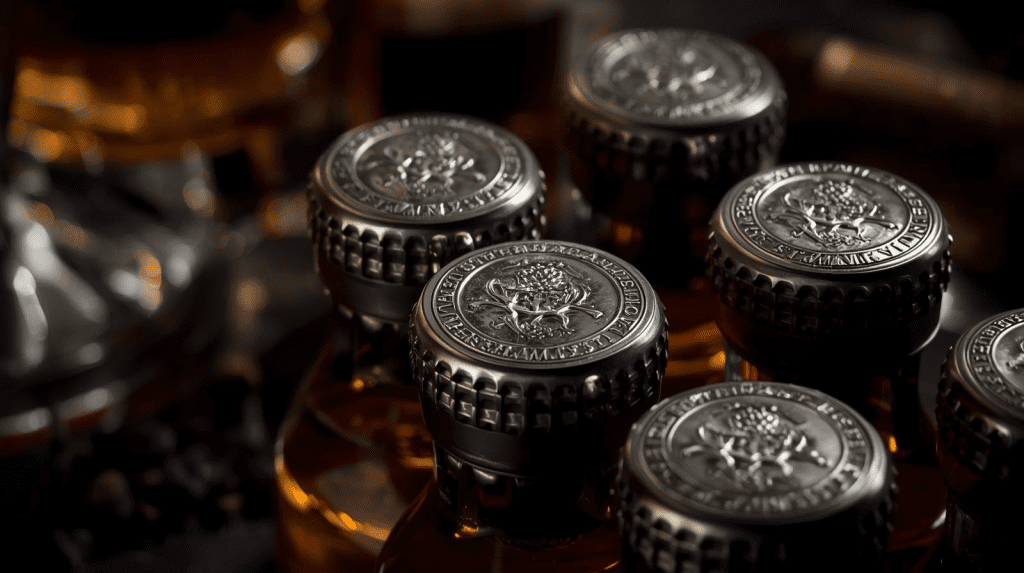
Zamac Spirits Bottle Caps Buyers Guide
On a spirits shelf, the closure is the only part of the bottle a customer touches before they buy. It is also the part most likely to break a launch: a lid that rocks loose, a plating finish that clouds after six months in 40% ABV, a shank that pops under air-freight pressure change.
Most spirits brands start with a wood or plastic bar-top because it is what the market shows them. Then they hit the ceiling — wood cannot hold a fine crest, plastic does not read as premium, and neither survives a global rollout without colour drift between batches. That is the point where brands start looking at zamac liquor bottle caps.
This guide is written for brand owners, packaging managers and sourcing teams who are specifying a metal closure for the first time. It covers the closure architectures that actually exist, the dimensional fit that decides whether your cap seals, what high-ABV spirits do to a plated surface, and the sequence from brief to bulk.All of these closures are produced in-house; browse the zamac spirits bottle caps range at the factory.
Why spirits brands move from wood and plastic tops to Zamac
Zamac (also written ZAMAK or Zamak) is a family of zinc-aluminium alloys — Zamak 3 and Zamak 5 are the two grades used for nearly all decorative closures. It is cast by hot-chamber die casting, which is what makes it different from every other metal option on the shelf.The same alloy choice is covered in more depth in our guide to pure zinc vs zinc alloys.
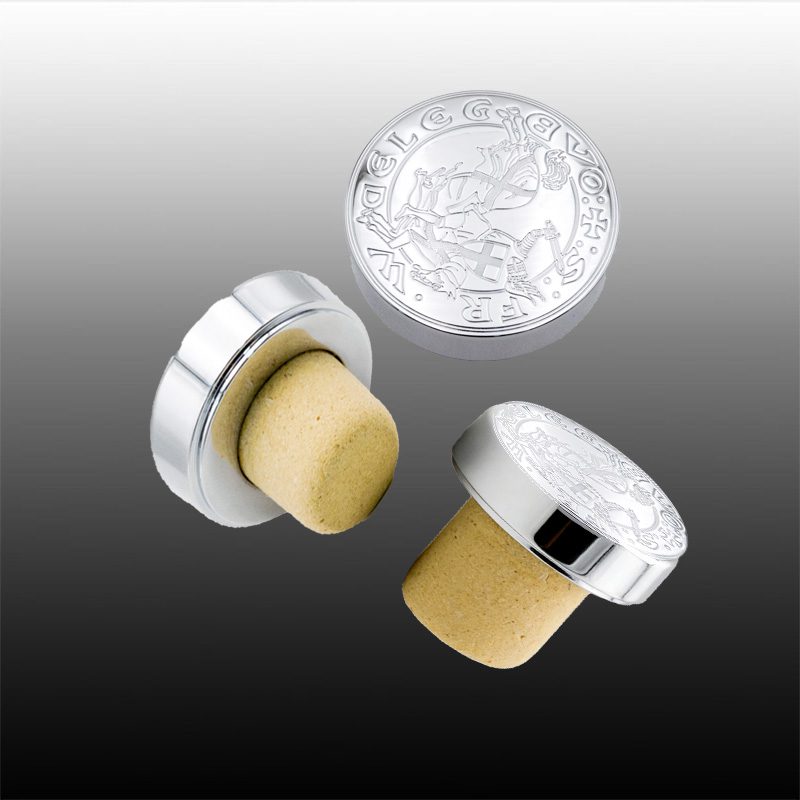
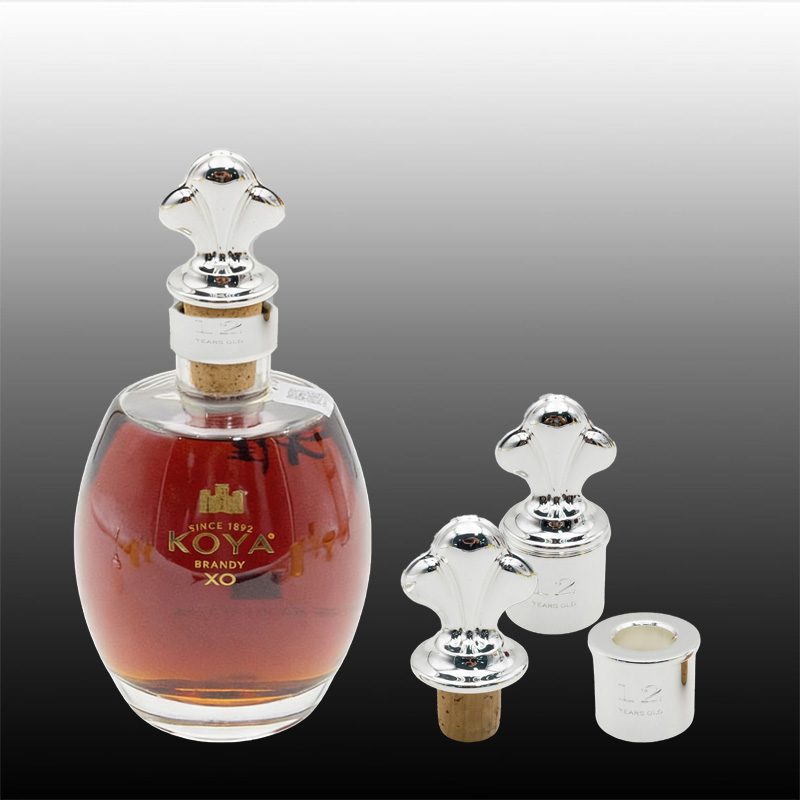
Detail reproduction. Die casting fills a steel mould under pressure, so a crest, a family coat of arms or a fine guilloché pattern comes out of the tool already formed. On wood you are limited to laser burn or foil stamp; on plastic you are limited by draft angles and sink marks. For a zamac brandy cap set or an ornamental limited edition, the design is the product.
Weight and haptics. Zamac has a density around 6.6 g/cm³ — roughly 2.5× that of aluminium by volume. A 60–70 g cap on a 700 ml bottle delivers the “heavy base, heavy top” signal that premium whisky and cognac buyers read unconsciously. This is weight you can specify: tell your factory the target gram weight and they will engineer wall thickness and internal coring to hit it.
Finish range. A single zamac head can be bright gold, matte black chrome, antique bronze, gunmetal, rose gold or a two-tone combination. That is the difference between one tool serving a three-SKU flight (your core expression, your 12-year, your travel retail exclusive).
Batch consistency. This is the quiet one. A wood top from a natural material will vary in grain and stain uptake between lots. A die-cast part out of the same tool and the same plating line does not — which is what you need when a retailer is comparing this year’s bottle against last year’s.
The three closure architectures spirits brands actually buy
Before you talk finishes, decide the architecture. Almost every spirits closure falls into one of three.
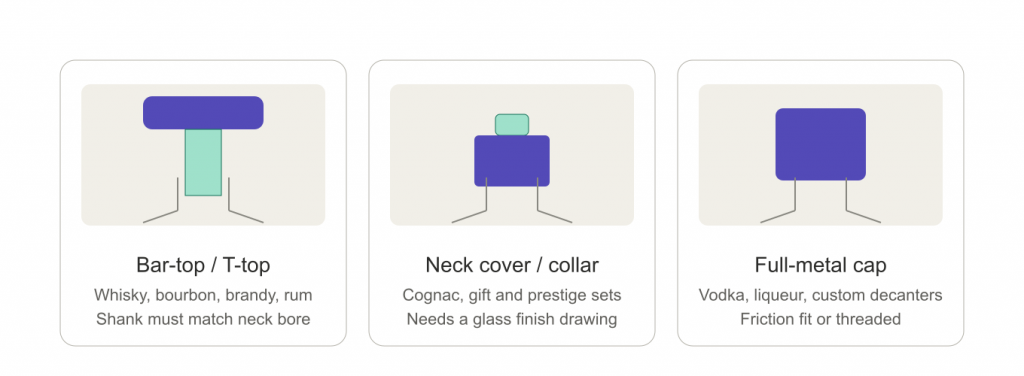
| Architecture | How it works | Typical use | What to watch |
|---|---|---|---|
| Bar-top / T-top with zamac head | Zamac decorative head bonded to a cork or synthetic (TPE/PU) shank that compresses into the neck | Whisky, bourbon, brandy, rum, craft gin — the default premium format | Shank-to-bore fit, extraction force, TCA risk on natural cork |
| Zamac neck cover / collar | Metal sleeve or capsule that slides over a standard stopper or cork and locks against the neck flange | Cognac, armagnac, Calvados, prestige gift sets | Neck flange profile; needs a finish drawing from your glass supplier |
| Full-metal decorative cap | One-piece or two-piece zamac shell, friction-fit or threaded, often with an inner liner | Vodka, liqueurs, baijiu, crystal decanter formats, limited editions | Inner liner material must be alcohol-compatible; thread pitch must match GPI/BVS spec |
A zamac cylindrical liquor cap or a zamac crystalline spirits bottle cap is usually the third type — a faceted or fluted one-piece shell designed to catch light next to a cut-crystal decanter. For whisky specifically, see our range of custom zamac whisky bottle caps.If your bottle is a custom decanter rather than a stock flint bottle, expect to supply the glass drawing before tooling starts, not after.For the same architecture applied to sparkling wine, see why zamac is preferred for champagne caps.
Getting the fit right: neck bore, shank and extraction force
Fit failures are the single most common reason a spirits closure project slips. They are also entirely preventable.
Standard spirits neck bores are 18.5 mm, 19.5 mm, 21.5 mm and 22.5/22.6 mm. The shank is specified roughly 1 mm larger than the bore to create a friction fit. That sounds simple until you learn that bore tolerances can drift ±0.5 mm between glass manufacturers — and at 18.0 mm a stopper that sealed perfectly at 18.5 mm will rock loose.
| Bottle format | Common neck bore | Common shank size | Typical closure style |
|---|---|---|---|
| 375 ml | 18.5 mm | 19.5 mm | Small T-top, wood or synthetic |
| 500 ml | 18.5 / 21.5 mm | 19.5 / 22.5 mm | Bar-top, craft and liqueur |
| 700 / 750 ml | 18.5 / 21.5 mm | 19.5 / 22.5 mm | Standard bar-top or custom T-top |
| 1 L | 21.5 mm | 22.5 mm | Medium-large head; match to shoulder width |
| 1.75 L | 21.5 mm or custom | 22.5 mm or custom | Visual balance needs physical testing |
Reference only. Final approval must be based on your glass supplier’s finish drawing plus a physical sample test.
Four things to lock before tooling:
- Measured bore ID — take it with a calibrated digital caliper at several depths, not from a spec sheet.
- Insertion and extraction force — ask for a tested force window. Too tight frustrates the consumer and can crack a thin neck; too loose leaks in transit.
- Compression set — long-term compression is what causes evaporation loss and headspace seal failure on reclosable stoppers.Sealing behaviour in more detail: zinc alloy wine stopper sealing technology.
- Shank material — natural cork (heritage story, FSC credentials, small TCA risk, dimensional variability) versus synthetic TPE/PU (dimensionally consistent, no TCA, solvent-resistant at high ABV, better on automated insertion lines).
If you are bottling on an automated line, synthetic usually wins on throughput. If you are selling a heritage single-cask story, natural cork earns its keep. There is no wrong answer — but it has to be a decision, not a default.
Alcohol resistance: what 40% ABV does to a plated cap.
See how surface coating raises corrosion resistance on zamac caps.
Spirits are a hostile environment for a decorative metal part. Ethanol is a solvent, it carries through micro-porosity, and it attacks the interface between the plating layers and the zinc substrate. This is where a perfume cap spec and a spirits cap spec diverge.
Ask your supplier to confirm all five:
- Alloy grade. Zamak 3 gives the finest detail reproduction and the best dimensional stability. Zamak 5 adds copper for higher hardness and tensile strength — worth specifying for tall, thin or structural parts.
- Porosity control. Hot-chamber die casting on a cap with 2.0 mm nominal wall thickness is routine, but gas porosity is what lets alcohol reach the substrate. Ask what process controls (vacuum, shot profile, gate design) are used, and request porosity inspection criteria.Process controls for minimising porosity in zinc die casting are covered separately.
- Plating stack. Decorative zamac is typically copper → nickel → top layer (chrome, gold, or PVD). The nickel layer is the barrier. A thin or discontinuous nickel layer is the root cause of almost every “the finish went cloudy” complaint.
- Sealer. A final e-coat or lacquer seal over the decorative layer is not optional for spirits. It is the difference between passing and failing an alcohol immersion test.
- Verification. Salt spray testing (ASTM B117) and an alcohol immersion / friction test on production samples — not on lab-only coupons.
If you export, also confirm the compliance documentation set you will need: food-contact migration declarations under EU 10/2011 and FDA 21 CFR for closure components, REACH and RoHS statements for the EU, California Prop 65 for the US, and — if you sell into the US — that your fill volumes meet TTB standards of fill for distilled spirits.Full document list: regulatory standards for zamac bottle caps in global markets. None of this is exotic, but it is much cheaper to collect before tooling than after.
Design and finishing options that sell on shelf
Once architecture and fit are settled, decoration is where the brand gets made:
- Embossed / debossed crest — formed in the tool, zero per-unit decoration cost afterwards, and it survives handling better than any applied mark.
- Laser engraving — good for batch codes, bottling dates, and limited-edition numbering.
- Epoxy or enamel infill — colour into a recessed logo; reads strongly on antique finishes.
- Antique / two-tone — a dark patina recessed against polished high points, which is how ornate zamac spirits caps get depth without extra components.
- PVD — harder and more abrasion-resistant than standard electroplating; worth the premium on a cap that will be handled in duty free and travel retail.
- Sandblast + partial polish — matte body with polished bevels, currently the most requested combination for premium vodka and gin.
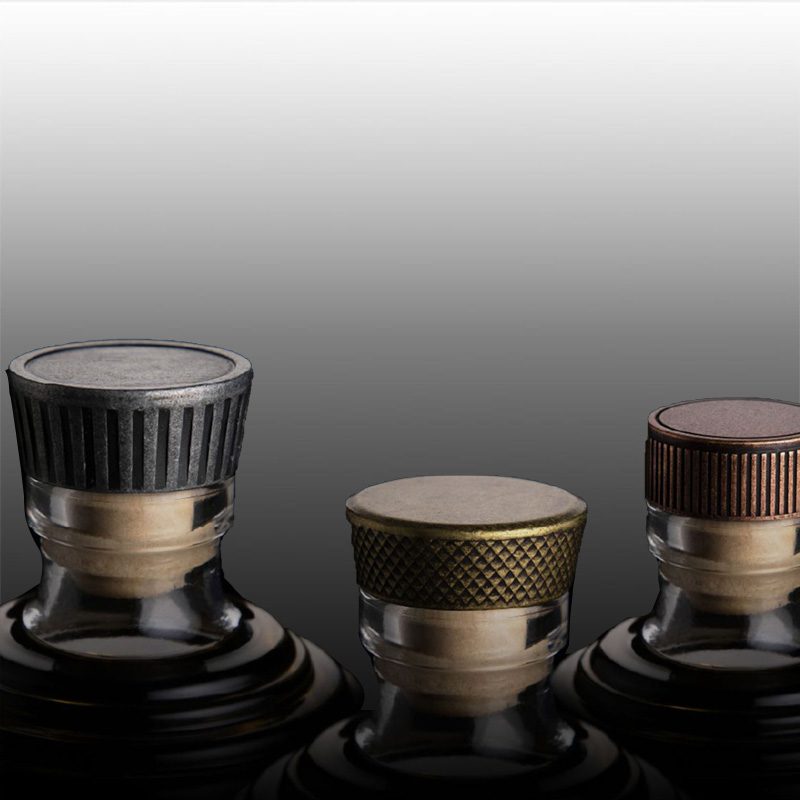
More on surface treatment techniques for zinc alloy die castings.
For a house with several expressions, the efficient route is one geometry with two or three finishes rather than three separate tools. It keeps tooling spend down and keeps the family looking like a family.
From brief to bulk: the OEM/ODM sequence
| Stage | What happens | Typical duration |
|---|---|---|
| 1. Brief & quote | You supply 2D (PDF/CAD) + 3D (STEP/IGES) drawings, or a physical sample; factory returns DFM feedback and quote | Quote within ~2 working days |
| 2. DFM review | Wall thickness, draft, coring for weight, gate position — changes here are free | 3–5 days |
| 3. Tooling | In-house mould shop cuts and trials the die | ~25 working days |
| 4. T1 sample | First parts off the tool, in the specified finish | ~15 days |
| 5. Range boards & golden sample | Agreed physical standard for acceptable colour and defect limits, signed by both sides | 5–7 days |
| 6. Mass production | Die cast → deburr → CNC → polish → plate → assemble | 25–30 days, quantity-dependent |
| 7. QC & packing | In-process inspection, pre-shipment sampling, blister tray + carton | 5–7 days |
Realistic planning figure for a first custom spirits closure: 10–14 weeks from signed drawings to goods on the water. For a repeat order on an existing tool: 4–6 weeks. Build that into your launch calendar before you book the bottling slot.Our zamac cap MOQ, tooling and lead time guide breaks the numbers down further.
The 18-point RFQ checklist
very line you leave blank costs about a week of clarification email with your zamac cap manufacturer. Below is the full list in plain text — copy it straight into an email, fill in the blanks and send it with your drawings. If you would rather send a filled-in form, use the spreadsheet below.
Product
- Application — perfume / wine / spirits / candle / other: ______
- Bottle or vessel supplier, plus neck finish drawing (PDF): attached? ______
- Neck spec — FEA 15 / FEA 13 / 18.5 mm / 21.5 mm / other: ______
- Closure type — friction / magnetic / threaded / screw / dropper: ______
- Target weight: ______ g
- Alloy grade — Zamak 3 / Zamak 5 / please advise: ______
Design
- 2D drawings (PDF/CAD): attached? ______
- 3D file (STEP / IGES / STL): attached? ______
- Logo method — emboss / deboss / laser / epoxy infill / print: ______
- Finish: ______ (Pantone reference or physical sample attached? ______)
- Special process — antique / PVD / sandblast / two-tone / other: ______
Commercial
- Target quantity per SKU: ______
- Number of SKUs / finishes: ______
- Estimated annual volume: ______
- Incoterm — FOB / EXW / CIF / DDP: ______
- Destination market(s): ______
- Compliance documents required — REACH / RoHS / Prop 65 / FDA / EU 10/2011 / other: ______
- Target delivery date: ______
Download the fill-in version: GCX_RFQ_Spec_Sheet.xlsx
FAQ
Are zamac caps safe for spirits with high alcohol content? Yes, when the plating stack and sealer are specified for it. What matters is not the base alloy but the barrier layers and the final seal — which is why you should require an alcohol immersion test on production samples rather than accepting a generic “corrosion-resistant” claim.Related: quality control measures for zamac caps.
What is the difference between Zamak 3 and Zamak 5 for a spirits cap? Zamak 3 reproduces fine detail best and holds dimension most stably. Zamak 5 contains copper, giving higher hardness and strength. For a heavy decorative head with a fine crest, Zamak 3 is usually the right call; for a tall, thin or load-bearing structure, ask for Zamak 5.
Can a zamac head be fitted to the cork shank we already buy? Usually yes. This is a common route — keep your existing bottling-line qualification and upgrade only the visible head. Send the shank drawing and dimensions so the head interface can be machined to match.
Do you make a matching set — cap plus base or plinth? Yes. Matched sets (cap, collar and display base in one finish) are a standard request for gift and travel-retail formats, and producing them together is the only reliable way to guarantee the finishes match.
What if our bottle is a custom decanter? Supply the glass finish drawing before tooling starts. Custom decanters frequently use non-standard bores, and a mould-matched stopper is the correct solution rather than forcing a stock size.
How much does a custom zamac spirits cap cost? Unit cost is driven by weight, tool complexity, finish stack and quantity — not by a published price list. Send the spec sheet above and you will get a quote against your actual part.
Next step
Send the checklist above with your drawings and we will return DFM feedback and a quotation within two working days. Our in-house tool and mould department delivers moulds in about 25 working days, and samples in about 15 days.
Request a Quote → | See our OEM/ODM process →
Browse the full zamac wine and spirits bottle cap range.
GuanChengXin (GCX) — a custom zinc alloy perfume cap manufacturer with 100+ employees, 80+ machines, in-house tooling, die casting, polishing, plating and assembly. Dongguan, Guangdong, China.