Wine and spirits buyers face a different closure problem than fragrance brands. A perfume cap sells an image; a spirits closure has to seal an alcoholic product for years, survive a bar-back’s hands, and still look deliberate under low light. Therefore the sourcing questions change: the format matters more than the finish, the liner matters more than the logo, and the sampling gates matter more than the price per piece. This guide walks through the decisions in the order they actually come up — format, specification, decoration, MOQ and sampling, documents — so you can send a complete RFQ the first time. If you are still building the supplier list, start with how to vet a zamac cap manufacturer before you send an RFQ; every check below assumes the factory has already passed those ten.
Step one: choose the closure format
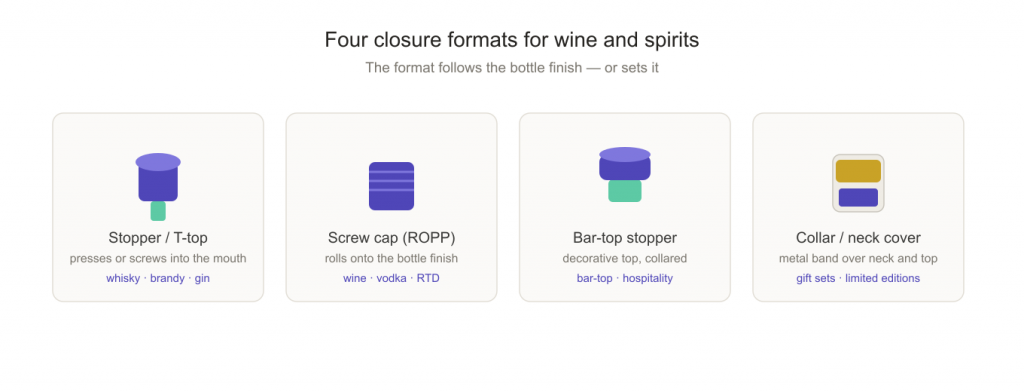
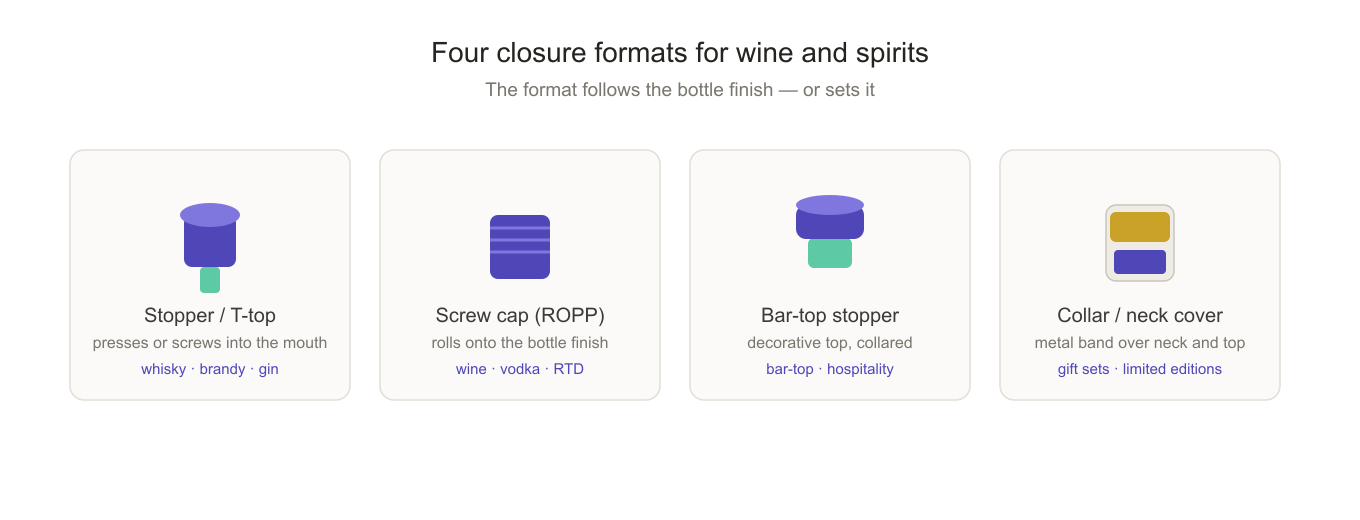
Four formats cover almost every wine and spirits programme. However, each one solves a different problem, and the wrong choice shows up at the bottling line rather than at the tasting.
| Format | How it works | Best for | Watch-outs |
| Stopper / T-top | A cork or synthetic shank with a turned top; presses or screws into the bottle mouth | Whisky, brandy, gin and premium spirits; gifting | The shank diameter must match the bottle mouth exactly |
| Screw cap (ROPP) | A threaded metal cap rolls onto the bottle finish | Wine, vodka, ready-to-drink and high-volume lines | It needs a ROPP finish on the bottle, not a cork finish |
| Bar-top stopper | A stopper with a decorative top, often collared or ribbed | Bar-top spirits, home bar and hospitality | The top adds height and weight to the pack |
| Collar / neck cover | A decorative metal band that covers the neck and top | Gift sets, limited editions, OEM upgrades | It hides the closure, so the liner spec still matters |
If the bottle already exists, the format follows the bottle finish. If you are still tooling the bottle, choose the closure first and specify the finish to match, because the two tools cut together and a late change costs both. For the material side of that decision — how zamak stacks up against cork, glass and plastic on a wine programme — our guide on the advantages of zamac wine bottle caps over traditional corks covers the trade-offs, and the metal wine stopper guide also shows how the T-top construction works in service.
Step two: put the specification on paper
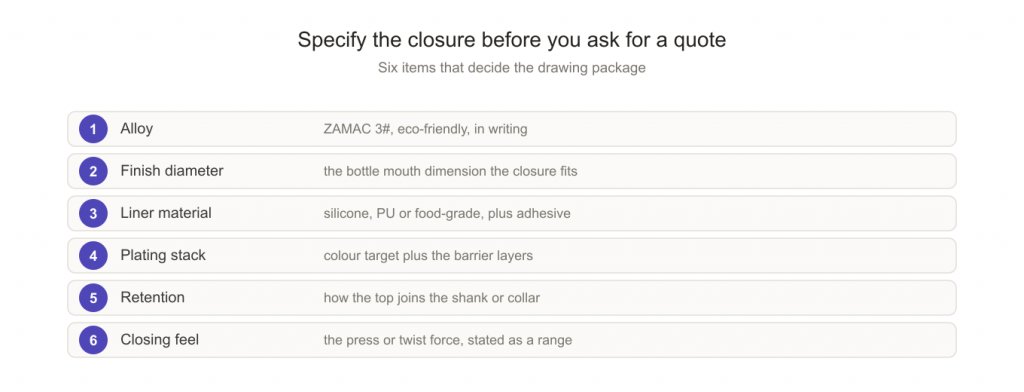
Most disputes at delivery, however, trace back to a specification the buyer never wrote down. The drawing package matters more in this category than in any other, because a spirits closure combines a cast metal part, a liner and a decorative finish in one assembly. Define these items before you ask for a quote:
| Spec item | What to define | Why it matters |
| Alloy | ZAMAC 3# (eco-friendly, low-lead) in writing at RFQ | A swap after tooling means requalifying the part |
| Finish diameter | The bottle mouth dimension the closure fits | A small mismatch fails the fit test, not the quote |
| Liner material | Silicone, PU or food-grade, plus the adhesive | The liner seals the alcohol; a debond turns a premium cap into a rattle |
| Plating stack | Colour target plus the barrier layers under it | The barrier, not the top coat, stops clouding and white rust |
| Retention | How the top joins the shank or collar | This joint takes the most handling in a bar |
| Closing feel | The press or twist force the user should feel | We state the target range on the drawing and confirm it at sampling |
Note the alcohol angle: spirits contain ethanol, and ethanol attacks some liners and some plating stacks over time. Therefore, ask the factory to test the production liner against your actual formulation rather than a lab substitute. The wider spec context — diameters, finishes, decoration depth and the brand-side decisions — sits in our zamac spirits bottle caps buyer’s guide.
Step three: decoration that survives the product
Embossing, deep engraving, Pantone-matched plating and colour anodising all work on zamak, and all of them also interact with the alcohol contact surface. Keep decoration off the liner face, and keep the plating stack tested on the production part rather than a flat coupon — a collar flexes in service, and a stack that looks right on a coupon can craze at the flex point. Our guide on what can be engraved on a perfume bottle cap covers what each method can and cannot do at production depth, and it applies to spirits formats as well.
Step four: MOQ, tooling and the sampling gates
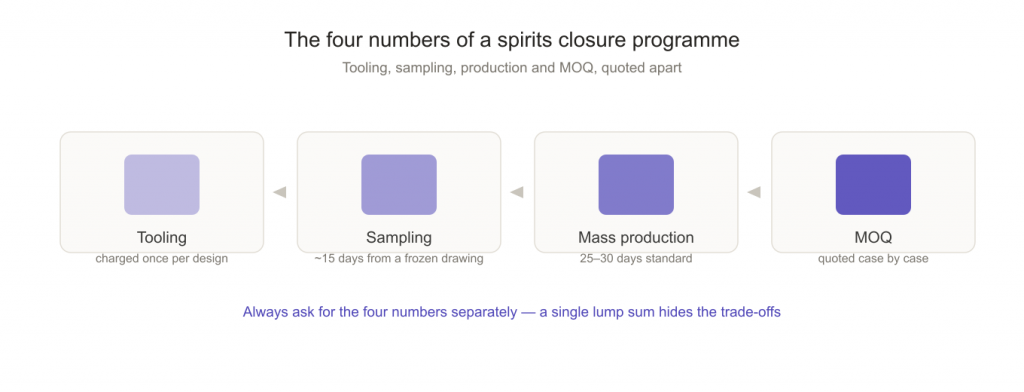
Programme economics for a spirits closure break into four numbers; therefore, buyers should always ask for them separately:
- Tooling — we charge it once per design; on our programmes, reorders and spare moulds do not carry a second mould charge.
- Sampling — about 15 days from a frozen drawing, quoted as its own line item, and credited against your first production order.
- Mass production — 25–30 days standard for a proven design.
- MOQ — we quote it case by case, because the design, the decoration depth and the colour count all move the number.
The sampling sequence matters as much as the dates: first, T1 parts off the tool, dimensional measurement against the drawing, then range boards for finish, a sealed golden sample, then FAI documentation for mass production. Our zamac cap sampling and T1 approval guide sets out the gates in order, and the MOQ, tooling and lead time guide explains how the four numbers interact.
Step five: documents and market entry
Spirits programmes travel, so build the document pack at RFQ stage rather than at the first shipment: alloy certification, a plating chemistry declaration, food-contact liner declarations, an FAI report on the assembly, a control plan and a COC per shipment. For the US and EU markets, our closure compliance guide for wine and spirits lists the regulations that reach the closure and the liner — REACH, RoHS, Prop 65 and migration testing among them.
What to check before you place the order
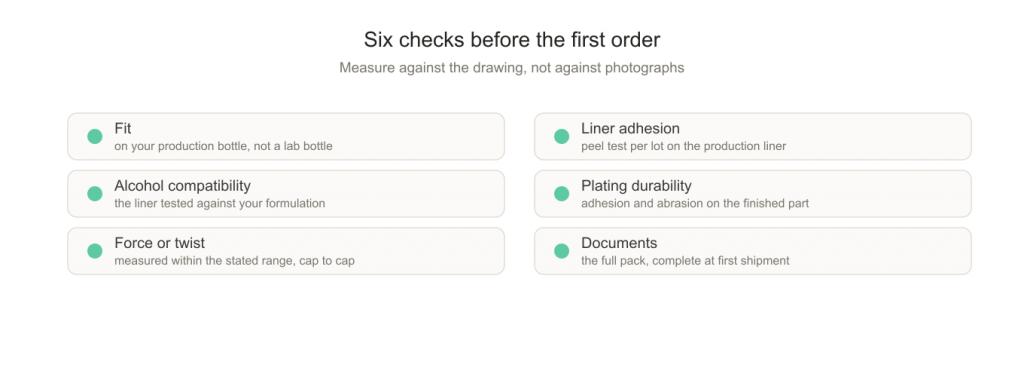
| Check | What good looks like |
| Fit | The closure seats on your production bottle, not a lab bottle |
| Liner adhesion | Peel test per lot on the production liner |
| Alcohol compatibility | The production liner tested against your formulation |
| Plating durability | Adhesion and abrasion on the finished part |
| Force or twist | Measured within the stated range, cap to cap |
| Documents | The pack above, complete at first shipment |
Two rules make the table work. First, measure against the drawing rather than against photographs — “the sample looks right” is not an approval criterion. Second, test the production formulation, because a liner change to a second supplier invalidates earlier results.
FAQ
Can zamac closures handle high-strength spirits?
Yes, when the liner and the plating stack suit the formulation. We test the production liner against your formulation at sampling, and we state the liner material and adhesive on the drawing so the spec stays fixed across reorders.
What liner options work with spirits?
Silicone, PU and food-grade liners all work; the choice, however, depends on the alcohol strength, the filling process and the shelf life you target. We confirm the liner at T1 and test adhesion per lot.
What is the MOQ for a custom spirits closure?
We quote MOQ case by case because it follows the design, the decoration depth and the number of colours. Small-batch trial orders run ahead of a volume commitment, which keeps a new format cheap to de-risk.
How long does a full programme take?
About 15 days for sampling from a frozen drawing, then 25–30 days for mass production on a proven design. We also quote tooling time separately at RFQ.
Can you match an existing closure we already buy?
Send the sample. We then reverse-engineer the dimensions, propose DFM improvements where the design fights the process, and quote against the sample rather than a description.
Which markets do you ship to?
We also ship worldwide, and the document pack covers the US and EU requirements most brands ask about. For the EU, our compliance guide lists the declarations we issue with each shipment.
Next step
Send the bottle, the shank or collar spec if you have one, the decoration target and the destination market. Our engineers also return DFM feedback and a quotation before we cut any tool. Browse the zamac liquor bottle cap and the zamac wine bottle cap collection for formats already in production, or read more about how we work as a custom zamac bottle caps manufacturer.
GuanChengXin (GCX) — zinc alloy die casting manufacturer in Dongguan, China. In-house tooling, die casting, CNC, polishing, plating and assembly for fragrance, spirits and home fragrance closures.